




Member of AWSA

  Info about AWSA


[Bios on Partners Page]

[Partners' Article List]

Lina AbuJamra

Sue Badeau

Dianne Barker

Twila Belk

Gail Bones

Harriet Bouchillon

Mary Carver

Pamela Christian

Lisa Copen

Erin Davis

Diane Dean

Deb DeArmond

Kelly DeChant

Danna Demetre

Nancy Leigh DeMoss

Melissa Edgington

Debbi Eggleston

Pat Ennis

Morgan Farr

Pam Farrel

Renee Fisher

Liz Cowen Furman

Sheila Gregoire

Doreen Hanna

Holly Hanson

Becky Harling

Debbie Harris

Paula Hendricks

Nali Hilderman

Cathy Horning

Kathy Howard

Mary James

Priscilla Jenson

Lane P. Jordan

Rebecca Jordan

Ellie Kay

Maria Keckler

Sylvia Lange

Debby Lennick

Peggy Leslie

Kathi Lipp

Kathi Macias

Melissa Mashburn

Dianne Matthews

Cindi McMenamin

Elaine W. Miller

Kathy Collard Miller

Lynn Mosher

Karen O'Connor

Yvonne Ortega

Arlene Pellicane

Ava Pennington

Laura Petherbridge

Gail Purath

Marcia Ramsland

Kaley Rhea

Rhonda Rhea

Vonda Rhodes

Charlotte Riegel

Cynthia Ruchti

Julie Sanders

Deedra Scherm

Judy Scharfenberg

Laurel Shaler

Stephanie Shott

Poppy Smith

Stacie Stoelting

Jill Swanson

Janet Thompson

Janice Thompson

Teri Thompson

Brittany Van Ryn

Leslie Vernick

Laurie Wallin

Julie Watson

Joan C. Webb

Cherri Williamson

Kathy C. Willis

Jamie Wood

Dawn Wilson


Entries in Kathy Collard Miller (9)

Thursday
Jul212016

3 Secrets for Cultivating Humility

Kathy Collard Miller is an author and speaker who encourages women to apply practical principles from the Word of God. In this Attitude UPGRADE, she explores some ways to cultivate humility.

"A lot of us think humility means debasing ourselves," Kathy said, "but being humble actually means acknowledging what God has done in our lives."

This is so refreshing! I (Dawn) have heard so many weak and unbiblical descriptions of humility. But Kathy is right on target.

Kathy continues . . .

The Greek word for humility originally was used by writers to communicate something negative: “groveling” or “abject.” But the Apostle Paul came along and turned it into God’s perspective.

Here’s how to cultivate humility.

1. Think rightly of yourself.

True humility is not thinking low of oneself but thinking “right.”

Romans 12:3 tells us God’s perspective: “For through the grace given to me I say to every man among you not to think more highly of himself than he ought to think; but to think so as to have sound judgment, as God has allotted to each a measure of faith.”

Author Warren Wiersbe wrote, “The truly humble person yields himself to Christ to be a servant, to use what he is and has for the glory of God and the good of others.”

2. Give credit to God.

God has given you strengths, gifts and talents, and if you reject them, you are rejecting God’s provisions.

Humility means giving credit to God.

And yes, each person has weaknesses. Humility acknowledges the need to receive God’s help to correct those weaknesses.

A word picture I heard years ago helps me. Sometimes a turtle shell can be found balanced on a fence post in the yards of Mid-western towns. No one believes that turtle climbed up there himself. No, he was placed there. You and I are like that turtle.

God places us in service whether it’s called parenting, employment, ministry, volunteering or listening. It’s His doing and we can acknowledge His work in us.

3. Be inspired by Jesus’ surrender.

The Apostle Paul tells us in Philippians 2:5-8 that the basis of humility is the surrender Jesus exemplified:

“Have this attitude in yourself which was also in Christ Jesus, who, although He existed in the form of God, did not regard equality with God a thing to be grasped, but emptied Himself, taking the form of a bondservant, and being made in the likeness of men. He humbled Himself by becoming obedient to the point of death, even death on a cross.”

Most likely none of us will be called to develop humility by dying for Christ’s sake, but the more we are willing to be misunderstood, maligned, gossiped about, or face any other difficulty will reveal and develop our surrender—from which springs humility.

Which of those three insights would you like to concentrate on so that humility can be stronger in your life?

Kathy Collard Miller loves to help women trust God more through her 50 books and her speaking in over 30 states and 8 foreign countries. Visit her website/blog and discover more about her speaking ministry here. Kathy has authored more than 200 magazine articles and more than 50 books, including Partly Cloudy with Scattered Worries and Never Ever Be the Same: A New You Starts Today. Her newest book is Choices of the Heart, a Bible study, available here.

Mirror Graphic adapted - 18th century vermeil mirror in the Musee des Arts decoratifs, Strasbourg ... By Gryffindor - Own work, CC BY-SA 3.0, https://commons.wikimedia.org/w/index.php?curid=5242020.

Turtle Graphic adapted - from the Oklahoma Ark Museum Blog.

Thursday
Apr212016

Stop Pressuring Yourself!

Kathy Collard Miller writes to help women be wise and productive. In this Biblical Thinking UPGRADE, she helps us consider the "pressures" in our life from the perspective of God's Word.

“Why does life feel full of pressure?" she said. "There’s so much to do, so much to decide. People expect a lot and every situation seems potentially disastrous.”

Pressure. Stress. I (Dawn) have thought much about this lately, dealing with some personal stressful circumstances. I'm wondering if my thought-processes contribute to the struggle. Does Kathy have a word for me? And you?

Kathy continues . . .

The pressures of life can easily add up and feel overwhelming. Even when we’re seeking God, it’s not easy to replace pressure with peace and joy.

I remember seeing how I added lots of pressure to my life without realizing it. I thought I was following God, but in my cloudy thinking, I was contributing to the pressure.

Of course, there are many ideas for diminishing pressure but here are three ideas I’ve found helpful. I hope one or more help you.

1. Downsize!

My mom taught me, my sister and my brother how to clean our rooms every Saturday. And that included washing the sheets! After I had a family of my own, I still washed our sheets every week, even though I felt mounting pressure because of a husband who worked long hours, two toddlers and trying to serve the Lord.

One day I mentioned to my neighbor Pat about washing the sheets every week. Pat casually said, “Oh really? I wash ours every two weeks.”

Shocked, I replied, “You mean it’s ok to do that?”

I realized in that moment I was pressuring myself to do something that wasn’t needed. As I began to ask myself if there were other pressures I was putting on myself unnecessarily, I found others.

What can you eliminate or do less often that will relieve some pressure?

Jesus’ said to Martha when she was trying to make so many dishes for company: “Martha, Martha, you are anxious and troubled about many things, but one thing is necessary” (Luke 10:41 ESV).

Of course we know He meant sitting at his feet like Mary, but maybe He also meant she could “downsize” the meal to include only one dish!

2. Re-read your journal.

Sometimes I’ll read my journal from a year ago or years ago.

I’m shocked to see that the things I worried about and felt pressured about weren’t really that important—in the end.

I wrote about what terrible things might happen if I didn’t do something just “right.” Or about the long range consequences if I made a mistake.

But without reading my journal, I wouldn’t be able to tell you now about those pressure-making circumstances. At the time, I felt pressured to pray exactly the right thing—as if I could know the future.

God worked things out often without me even knowing how to pray.

Proverbs 3:5 tells us not to lean on our own understanding. I think we can diminish pressure by not expecting ourselves to know exactly how to pray.

Yes, pray! But trust in God’s compassionate grace to know the right way to answer, even if it’s “no.”

3. Abide.

Lately, I’ve concentrated on living in the moment by following Jesus’ command to “abide”: “As the Father has loved me, so have I loved you. Abide in my love” (John 15:9 ESV).

For me, that has looked like being alert to God’s leading moment by moment and trusting His love can cover when I misunderstand.

It has meant believing:  

“God will give me enough time and energy to do what He wants me to do as I seek Him.”

If something doesn’t get done as I expected and I abided in Him, then that’s what He wanted to happen. I don’t have to feel pressured and beat myself up.

Which of those three insights could help you to resist pressuring yourself?

Kathy Collard Miller loves to help women trust God more through her 50 books and her speaking in over 30 states and 8 foreign countries. Kathy recently wrote Never Ever Be the Same: A New You Starts Today; and Choices of the Heart (Elk Lake Publishers). Visit Kathy's website/blog.

Graphic from Morguefile.

Tuesday
Jan122016

3 Ideas for Overcoming Procrastination

Kathy Collard Miller is an honest, transparent woman and when she talks about making wise choices, I know she has learned from experience. In this Choices UPGRADE, she deals with the tough topic of procrastination.

“Why do I keep procrastinating?" Kathy said. "I want to be stop delaying but I keep putting things off.”

Truth be known, I (Dawn) am a real pro at putting off the inevitable. At least in some areas of my life. I needed Kathy's refresher course in dealing with this weakness—procrastination!

Kathy continues . . . 

Just the other day I figuratively shook myself by my lapels and asked, “Kathy, why do you let the dishes stack up? It looks so messy!”

I had to be honest with myself that I call myself dependable but I’m selectively dependable. I let things go I should get done and as a result there is increased clutter, dirt and messes. I don’t like the results, but I don’t seem motivated to do what I should.

As I faced my problem, I began making some commitments led by the Holy Spirit.

Here are three ideas He used for me; I hope they are helpful for you if procrastination is one of your weaknesses.

1. Institute the 30-Second Rule.

Even though so much can get done in 30 seconds or one minute, I still put things off. For instance, I pull up my email account on my phone and receive a message that I could easily answer in 30 seconds or a minute. But because I don’t prefer poking that tiny alphabet pad or it’s too noisy to use the microphone, I tell myself I’ll wait to answer when I get to my desk. But then when I get to my desktop computer, so many emails have added up I have a big job—and I delay responding!

If I’d been willing to do “little” things rather than waiting, it wouldn’t be overwhelming.

That’s why I’ve been telling myself, "If something can be done within 30 seconds or a minute, even two minutes, do it right then." As a result, a fast answer to an email or text will save me time later and not feel overwhelming.

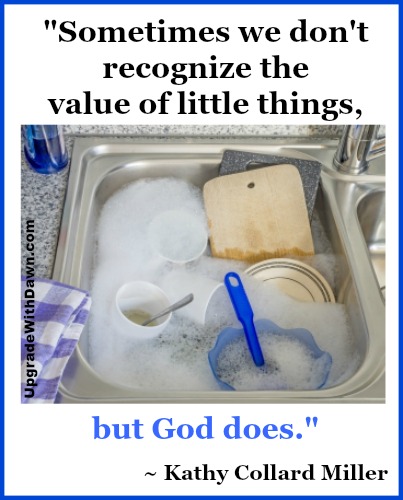
Sometimes we don’t recognize the value of little things, but God does. He says in Zechariah 4:10: “Do not despise these small beginnings, for the LORD rejoices to see the work begin" (NLT).

2. Recognize your motive for wanting to put things off.

I often wondered why I neglected doing the dishes. After all, instead of putting a dish into the sink or onto the counter, I could have used the same energy and time to stick it into the dishwasher—and it would be done!

Then one day after loading the dishwasher with dishes I could have loaded quickly over a day or two, I paid attention to my emotions. I recognized the sense of satisfaction in that moment. It felt good to transform the kitchen from messy to clean.

In a sense, my anticipation of that accomplishment had been rewarding—and motivating my procrastination. I knew I would feel like I had succeeded at something and so I didn’t complete the small tasks.

To combat procrastination, especially involving clutter, pay attention to your emotions. What emotion does waiting provide?

Whether it’s transforming a dirty kitchen or clearing off your desk, look to God for your satisfaction and joy. Anything that replaces Him is an idol. His approval is what we should seek because He wants to tell us, “Well done, good and faithful servant” (Matthew 25:21).

3. I’m afraid of the response I’ll receive for taking action.

Whereas we just talked about the satisfaction of success, we can also procrastinate because we fear the potential “pain” that’ll result from taking action.

Maybe you’ve been putting off responding to that email because you’re convinced whoever receives it will become angry. Or you don’t know exactly what to say to your friend and so you delay—waiting for just the right words to show up in your mind.

But in making those choices of delay we aren’t trusting God.

  • We’re trying to control the situation or another person so that we can protect ourselves from pain.
  • We’re leaning on our own ideas and that’s contrary to Proverbs 3:5-6: “Trust in the Lord with all your heart, and do not lean on your own understanding. In all your ways acknowledge him, and he will make straight your paths” (ESV).

If we recognize our procrastination as not trusting God, then we’re saying He can’t be in charge of the results.

Since He’s sovereign and therefore in charge of everything, He could literally bring a good result from our poor words, and He can bring an unexpected result (what seems negative at the time) from our good words.

We can’t control what happens but we can seek Him for wisdom; then take action and trust Him for the resulting “straightened path.”

I know these three ideas have been instrumental in seeing God’s work in empowering me to take action and increase my trust in Him.

In fact, just this morning, I responded to God’s prompting—finally—about suggesting a book idea to my agent. I really didn’t think he would like it and I feared the seeming “rejection.” But he quickly wrote back and said, “I like this and I think I know a publisher who would be interested.”

I don’t know what will happen, but for now I know I didn’t procrastinate (much!) and God may have a surprising result.

Which of those three insights could help you to resist procrastination?

Kathy Collard Miller loves to help women trust God more through her 50 books and her speaking in over 30 states and 8 foreign countries. Learn more about Kathy's unique ministry at her website/blog. Her latest book is Never Ever Be the Same: A New You Starts Today (Leafwood). 

Graphic adapted, Image courtesy of Mister GC at FreeDigitalPhotos.net.

Thursday
Sep172015

Choosing More than 'Grin and Bear It'

Kathy Collard Miller encourages women to trust God so they can make wiser choices. In this Attitude UPGRADE, she challenges a popular statement with a more biblical perspective.

“Things are tough but that’s OK," Kathy says. "I’ll just wait it out and it’ll get better.”

When I (Dawn) find myself in the midst of struggles, I see this as an opportunity to trust the Lord — most of the time. But I'll admit there have been some situations where I tried to "gut it out" myself. And that never works!

Kathy continues . . . 

Have you ever considered your trials and found comfort through thinking, “This too will pass”?

That phrase sounds benign enough, but I’m wondering if it leaves out God in some way. Because, at least for me, it supports in my heart an attitude of, “I’ll just grin and bear it until this trial goes away.”

It doesn’t support, “God, even if I have to persevere through this trial for a long time, I’m going to call upon you and not depend upon my own inadequate power.”

Would you like to embrace the second attitude? Here’s how:

1. Recognize how “Grin and Bear It leaves out God.

I became aware of how I was leaving out God because of that attitude some time ago. As I struggled to trust God for His provision of joy and contentment in the midst of being my mother-in-law’s caregiver, I thought, “This too will pass.”

And then on the heels of that thought came, “If I just knew how much longer Audrey was going to live, I could be more patient and kind.”

I was thinking I could be more patient because I would be gritting my teeth, just waiting for the trial to end. But that’s not depending upon God.

2. Choose active joy not passivity.

“This too will pass” is very passive. It’s allowing circumstances to dictate our responses rather than looking to God.

James 1:2-4 give us the key to active joy:

“Consider it all joy, my brethren, when you encounter various trial, knowing that the testing of your faith produces endurance. And let endurance have its perfect result, so that you may be perfect and complete, lacking in nothing” (NASB).

That verse contains active and “being aware” words, not closing our eyes to God’s help. Being active is when we pay attention to the purposes of difficulties.

Problems become God’s vehicle to growth. That can’t happen if we’re closing our eyes to what God wants to do.

3. Be aware moment by moment.

In the midst of caring for my mother-in-law, I examined that phrase, "This too will pass," more deeply. I saw that I wasn’t living in real time but in the future when things were guaranteed to get better. But there’s no guarantee life will get better. Life doesn’t become perfect until we enter heaven. Each moment and day of our lives is an opportunity to see God’s love strengthen us.

No wonder God doesn't tell us the future.

If we knew a trial was going to last a long time, we'd give up. If we knew a trial was going to be short-lived, we would grin and bear it.

We're supposed to relax in God's power moment by moment, depending upon Him, allowing Him to provide all we need. And then He’ll receive the glory, not us!

These three truths began to transform my thinking. No longer was I depending upon my limited knowledge and my strategy of passivity, but I was seeking God more passionately and seeing His hand of provision. I became more patient with my mother-in-law and saw how God was doing a work in me.

When my mom-in-law left for heaven, I knew I hadn’t been perfect, but I knew God had transformed my life now and it wasn’t in “the sweet by and by.”

That was affirmed when, a short time later, I became the main caregiver for my own mother. God took what He’d taught me and applied it to this new challenge. God never wastes anything, but we won’t see that if we’re just grinning and bearing it.

Examine your own life. Are there ways you have the attitude “this too will pass?” What is God inviting you to do about it?

Kathy Collard Miller loves to help women trust God more through her 50 books and her speaking in over 30 states and 8 foreign countries. Her website/blog is www.KathyCollardMiller.com. Kathy's newest book is Never Ever Be the Same: A New You Starts Today(Leafwood). It gives insights into the underlying reasons for unhealthy choices and how to have increased trust in God to make wiser choices. It contains biblical principles, insightful stories, and helpful instruction. It also offers individual and group discussion questions.

Graphic adapted: Image courtesy of nenetus at FreeDigitalPhotos.net. 

Monday
Mar162015

Anger Expert or Patience Pro?

Kathy Collard Miller is an author and speaker who encourages women to trust God. In this Attitude UPGRADE, she helps us trust the Lord with an attitude that can be destructive:  Anger! 

“Why do I keep getting angry?" Kathy said. "I want to be patient, but life and people are aggravating."

I (Dawn) used to think anger was other people's problem. I didn't have a problem losing my temper.

But if we have an undercurrent of anger, it can burst forth in other problems like bitterness, an unforgiving spirit or even something as simple as avoiding people.

Kathy continues . . . 

Life and people are aggravating. We pray for patience, but as someone has said, “Don’t pray for patience; God will give you many opportunities to practice.”

That was certainly true for me.

For many years, I was an anger expert. It was my “go-to” response. I prayed for deliverance but I still was destructively angry. In moments of temptation, I felt helpless and believed I didn’t have a choice.

But the truth is, anger is a choice.

Holding ourselves responsible rather than excusing our destructive reaction will lay a foundation for slowing down our reactions and allowing God to show us alternatives.

How can we “slow down”? When life (or someone) throws something aggravating at us, we need to literally take a deep breath and ask ourselves, “What’s going on here?”

Here are three causes of anger that you can consider in that moment.

1. Anger comes from having a goal blocked.

When we desire a certain thing and someone does something or says something that blocks that desire, we react in frustration. Unfortunately, this only means that that “certain thing” has become more important than God. We are choosing a destructive reaction to make sure we receive what we think we need and we’re not trusting that God can provide it for us.

We don’t have to force anything to happen when we truly believe God will provide what we need. He promises in Philippians 4:19:

“And my God will supply all your needs according to His riches in glory in Christ Jesus.”

In that moment of “slowing down,” ask yourself, “Is there something I value that I think is being withheld? If so, can I choose to trust that God will provide what’s best for me according to His plan?”

2. Anger’s source could be a fear of being seen a certain negative way.

Since childhood, I’ve been very sensitive to not appearing stupid. That seems horrible to me. So when someone treats or responds to me with what seems like a suggestion that I’m stupid or don’t know something, I can become angry.

Why does anger seem like a solution? Because my anger points to something they do wrong and it takes the focus off of my “stupidity.”

Sometimes, my husband, Larry, will sincerely ask me, “What were you thinking when you did that?” What do I “hear”? “You must have been stupid to choose that.” I’m embarrassed and feel shamed. So what do I do? Point the finger back onto him with an angry response by rehearsing some way that he did something wrong. But I can choose differently in God’s power.

In that moment of “slowing down,” ask yourself, “Is there some way I don’t want to be seen right now?" Regardless of how I’m viewed by others, God views me as His daughter through my inheritance in Christ, as Ephesians 1 says.

3. Anger may erupt from not knowing what else to do.

For instance, when my two-year-old disobeyed me, I felt helpless, not knowing how to respond. But forming a plan beforehand empowered me to have options. I wrote down in a column the primary ways my strong-willed daughter disobeyed me. Then in the opposite column, I wrote out one consequence I could give for each disobedience. I then posted the paper where I could see it. Having options removed my helpless feeling, and my anger.

Of course, we can’t anticipate every situation of life that might come our way, but we can try to plan as much as possible with God’s wisdom.

Then in that moment of “slowing down,” ask yourself, “What options do I have? Lord, enlighten my thinking right now. You promise in James 1:5 to give me wisdom.”

God used an awareness of these three possible causes of anger to transform my responses. I actually did become more patient . . . and wise.

Which of those three sources cause your anger most often and how does God want to use that knowledge to empower you to be more patient?

Kathy Collard Miller loves to help women trust God more through her 50 books and her speaking in over 30 states and 8 foreign countries. Kathy’s latest book is Never Ever Be the Same: A New You Starts Today (Leafwood) from which this article has been adapted. Check it out at http://amzn.to/1ITmLfy. Visit Kathy's website/blog at www.KathyCollardMiller.com.

Graphic adapted, Image courtesy of stockimages at FreeDigitalPhotos.net.