


Search
Follow UPGRADE

   Member of AWSA

  Info about AWSA


[See their Bios on the Partners Page by clicking on the Blogger box, above]

     PARTNERS:

Lina AbuJamra

Sue Badeau

Dianne Barker

Twila Belk

Dr. Michelle Bengtson

Gail Bones

Harriet Bouchillon

Mary Carver

Jeanne Cesena

Pamela Christian

Lisa Copen

Erin Davis

Diane Dean

Deb DeArmond

Kelly DeChant

Danna Demetre

Melissa Edgington

Debbi Eggleston

Pat Ennis

Morgan Farr

Pam Farrel

Sally Ferguson

Liz Cowen Furman

Gail Goolsby

Sheila Gregoire

Kate Hagen

Doreen Hanna

Holly Hanson

Becky Harling

Debbie Harris

Nali Hilderman

Cathy Horning

Kathy Howard

Mary James

Priscilla Jenson

Lane P. Jordan

Rebecca Jordan

Ellie Kay

Maria Keckler

Sylvia Lange

Debby Lennick

Peggy Leslie

Kathi Lipp

Kolleen Lucariello

Kathi Macias

Paula Marsteller

Melissa Mashburn

Dianne Matthews

Cindi McMenamin

Elaine W. Miller

Kathy Collard Miller

Lynn Mosher

Karen O'Connor

Yvonne Ortega

Arlene Pellicane

Ava Pennington

Laura Petherbridge

Gail Purath

Marcia Ramsland

Kaley Rhea

Rhonda Rhea

Vonda Rhodes

Cynthia Ruchti

Julie Sanders

Judy Scharfenberg

Deedra Scherm

Laurel Shaler

Joanie Shawhan

Stephanie Shott

Poppy Smith

Susan K. Stewart

Stacie Stoelting

Letitia "Tish" Suk

Jill Swanson

Janet Thompson

Janice Thompson

Teri Thompson

Brittany Van Ryn

Elizabeth Van Tassel

Leslie Vernick

Laurie Wallin

Julie Watson

Joan C. Webb

Shonda Savage Whitworth

Cherri Williamson

Kathy C. Willis

Debbie W. Wilson

Nancy DeMoss Wolgemuth

Jamie Wood

And UPGRADE'S Founder

   Dawn Wilson


Entries in Activism (2)

Thursday
Sep192019

A Christian Response to Suicide

Note: This article is run to coincide with National Suicide Prevention MonthSeptember 2019. If you or someone youi know is in an emergency, call The National Suicide Prevention Lifeline at 1-800-273-TALK (8255), or call 911 immediately.
Susan K. Stewart offers practical solutions to real-world problems. In this special Health UPGRADE, she encourages people to take a biblical view of a tough issue: suicide.

"'I tried to hang myself.'

"Shock does not convey my feelings," Susan says, "when my son spoke these words over the phone."

I (Dawn) recently tried to help a neighbor whose nephew took his own life. As I shared words of hope with my neighbor and her sister, I saw first-hand the deep, stigmatized pain in those left behind. I'm grateful for people like Susan who help us understand positive, biblical ways to address suicide and encourage others.

Susan continues . . .

I am the one in the family who remains calm during a crisis, falling apart afterwards. I tried to sound calm and collected. All I could manage “Why did you do that?”

This scene came flooding back when I heard over the phone just days ago, “Judy committed suicide.”

The family member who called went on to explain the circumstances, but I didn’t hear. My mind was back twenty years when I received the call from my son.

The shock of the news; the relief my son was still alive.

While I was processing the memory, the caller made another statement that gave me pause: “She was so religious. I didn’t think she’d ever do something like this.”

Yes, our loved one was a Christian. Yes, she did rely on God. Yes, she took her own life. Does that mean she wasn’t a “true” Christian? Does that mean she missed out on eternal life?

Why is it non-believers think believers won’t end their lives?

Why will some Christians condemn Judy for taking her life and also my son for attempting?

The church I grew up in taught suicide was an unforgivable sin because it is the taking of a life, murder, for which the person is unable to seek forgiveness. I couldn’t reconcile the love of Jesus with the shunning of families whose loved one had died at their own hand.

I later learned the only unpardonable sin is the blasphemy or, as it is translated in The Message, “when you reject the Holy Spirit” (Matthew 12:31). Total rejection of God.

If some churches teach the taking on one’s life is unpardonable, no wonder those outside the church think someone who is “religious” would not do such a thing. Why would a Christian do a such thing and not be able to be forgiven?

In Judy’s case, physical pain was so overwhelming even the heavy doses of narcotic prescriptions couldn’t overcome it. Her physical pain caused emotional and mental pain for which she was seeking relief.

What can we do to help believers and non-believers through the tragedy of suicide without guilt or condemnation?

1. Treat the family of a suicide victim as we would any other family grieving.

Prepare meals, offer to sit silently, pray with them, offer a comforting memorial service.

This family is facing a double burden:

  • grieving the loss of a loved one, and
  • reconciling the act itself.

They may be dealing with the belief their loved one committed an unforgiveable sin.

2. Understand the unique nature of the death.

Suicide is different than other deaths because of misunderstandings and stigma attached. The family members may be embarrassed or angry with themselves for not recognizing the classic signs.

Some families do not want the suicide revealed. While this sets up a veil of secrecy, which in itself may be destructive, we need to be respectful of their wishes.

3. Walk through the process

Immediately following the death, a police report will be taken. Family members and friends will be interviewed.

Having someone sit in support during this process takes the sting away.

Most cases of a suicide require an autopsy will be performed. Sometimes this process can take more than a month. There will be no body to bury for a long while. For some, this is an added burden to the grief.

Often not considered is clean up. Often that clean up will be the task of the family … an unbearable task. Someone may be needed to handle the details.

If the death is in the home, immediate family may need some place to stay. The offer of a quiet bedroom or a place for children to be comfortable may be welcome and better than staying in a hotel.

4. Help find support in the following weeks and months

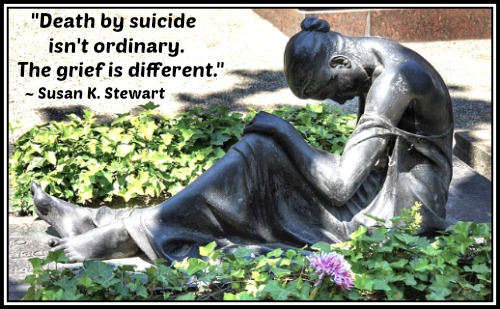
Death by suicide isn’t ordinary. The grief is different.

Yes, loved ones will go through the various stages, but they may get stuck in the anger stage. Anger at themselves as well as their loved one.

Unanswerable questions are asked. Loved ones need the support of those who have walked the road. If a local group isn’t available, individual support may be needed.

I’m thankful my son’s attempt to take his life was unsuccessful. Although it was painful, the experience changed me.

"As God has comforted me, I am able to comfort others" (2 Cor. 1:3-4).

It isn’t necessary to have experienced a loved one’s suicide to help.

  • Learn how to help.
  • Speak to church leaders.
  • Seek God.
  • If called, step out in faith.

What would God have you do to support those grieving a loss from suicide?

Susan K. Stewart, Acquisition Editor with Elk Lak Publishing, is a teacher, writer, and speaker known for practical solutions to real-world situations. Her books include Harried Homeschooler’s Handbook: Finding Hope in the Havoc, Preschool: At What Cost?, Science in the Kitchen: Fearless Science at Home for All Ages, the award-winning Formatting e-Books for Writers. She brings her inspiring and encouraging messages to online and in-person conferences about homeschooling, writing, and editing. The Stewarts live in Central Texas with their three dogs, three cats, nine chickens, and a couple of donkeys. They have three children and six grandchildren. You can read more of Susan’s practical solutions at www.practicalinspirations.com.

Graphic adapted, courtesty of Richard Mcall at Pixabay.

Thursday
Aug302018

5 Ways to Impact the Abortion Crisis in America

Morgan Farr takes tough stands because she is a strong woman with a tender heart. In this Biblical Thinking UPGRADE, she urges Christ-followers: Don't be complacent when it comes to protecting the unborn.

"This summer season has been rife with discussions about abortion laws across the world," Morgan says, "but especially in the United States of America."

I (Dawn) remember years ago when Christians in churches all across our nation were moved to pro-life action, but recently wondered, "Where are the YOUNG VOICES crying out for the lives of the unborn?"

Thank the Lord, Morgan is a powerful young voice!

Morgan continues . . . 

With the retirement of Supreme Court Justice Kennedy, an open seat on the Supreme Court of the United States means that the landscape of abortions in the United States could be about to change.

With roughly 3,657 abortions happening every single day in the United States, abortion is a topic that the body of Christ needs to address. But this is the point where many Christians get uncomfortable because they don’t know what to do or say.

 In fact, 57% of Millennials don’t know even the most basic facts about the landmark case Roe v. Wade[1] which legalized abortion in the United States.

So today, I am going to share my top five ways to impact the abortion crisis without relying on emotional arguments.

1. Understand the Terminology. 

There are a lot of labels that are bandied about in the abortion debate, but they all fall into one of two camps:

You either support abortion or you don’t.

The pro-life one is pretty simple, you believe life begins at conception and you are therefore you do not support abortions.

Meanwhile, the pro-choice label is really just brilliant marketing. What it means that you believe women should have the right to choose to end the baby’s life.

Pro-choice is often interchangeable with pro-woman, meaning that if you really care about women then you believe they should be able end a baby’s life. If you are not pro-choice you are almost always labeled as anti-woman.

2. Understand the Science.

The number one argument that most pro-choice advocates use is that the woman has a right to choose to end a pregnancy because the baby isn’t a person yet. The baby will, oftentimes, be referred to as “the fetus” (Latin for offspring) to help in the dehumanization.

This is the most basic way that abortion advocates have skewed the way people think about unborn children—by connecting development with personhood.

However, stage of development does not, in fact, define personhood.

Personhood is defined as "the quality or condition of being an individual person."

The exact moment when a sperm penetrates the egg, an entirely new organism is formed called a zygote, and it is the earliest stage of human development. The zygote is composed of brand new human DNA, meaning it is entirely unique. This unique zygote will develop for the duration of his or her time on earth.

The development goes like this:

Zygote, fetus, baby, toddler, preschooler, grade schooler, teenager, adolescent, adult.

The zygote carries the same completely unique DNA all the way through development into adulthood.

The person is the same unique person, with all their own qualities from conception to death. This means that in the act of abortion (whether chemical or surgical) the woman is killing a unique individual, not a portion of her own body.

3. Understand the Impact.

In 1973, the Supreme Court of the United States decided in the case of Roe v. Wade that abortion is legal. It also set guidelines in place breaking pregnancy into three trimesters.

 The guidelines for each trimester are:

  • 1st trimester—The state cannot regulate abortion (due to the woman’s right to privacy) aside from requiring that the medical procedure be performed by a licensed doctor in medically safe conditions.
  • 2nd trimester—The state may regulate abortion if the regulations are related to the health of the pregnant woman.
  • 3rd trimesterThe state may prohibit abortions unless abortion is necessary to save the life or health of the mother. (This means that the state can protect the life of the unborn child because the life’s potential outweighs the woman’s right to privacy).

According to the National Right to Life Committee, there have been approximately 60,069,971 abortions performed legally since the 1973, Roe vs. Wade decision.

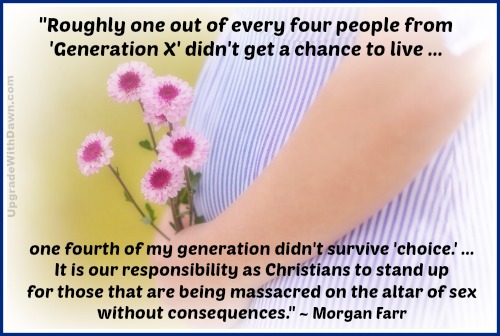
That means that roughly 1 out of every 4 people from “Generation X” didn’t get a chance to live.

In a recent poll, a Public Religion Research Institution survey gathered that 65 percent of 18- to 29-year-old Americans believe that abortion should be legal in almost all cases. [2]

This means that the numbers of unborn children lost to abortion will only climb in the future unless something is done to end the massacre of unborn children. 

4. Vote in EVERY Election.

In the United States of America, we have the privilege of electing the executive, legislative and judicial branches of our government. Get out and vote in every single election.

Local votes matter; midterm elections matter.

Do your own research. Find out about each candidate’s stance on abortion and vote accordingly.

Encourage your friends and family to vote. Help to get people to the polls by organizing a carpool.

5. Pray, Pray and Pray Some More! 

Prayer is the single most important aspect of having an impact on the abortion crisis in America.

 I cannot emphasize this enough.

  • Pray for wisdom for our country’s leadership.
  • Pray for those writing the laws to be convicted about the murder of unborn children.
  • Pray for the women who are seeking these abortions.
  • Pray for the men who helped to conceive these children.
  • Pray for the American people to wake up and realize that “aborting a fetus” is just a pleasant way of saying “murdering a child”.

To put it in perspective for you, roughly one fourth of my generation didn’t survive “choice”.

Psalm 139:13-16 says, “For you created my inmost being; you knit me together in my mother’s womb. I praise you because I am fearfully and wonderfully made; your works are wonderful, I know that full well. My frame was not hidden from you when I was made in the secret place, when I was woven together in the depths of the earth. Your eyes saw my unformed body; all the days ordained for me were written in your book before one of them came to be."

  If we truly believe that the Bible is the Word of God and we are to follow His instruction we cannot stand idly by any longer as the abortion industry robs the world of its future.

It is our responsibility as Christians to stand up for those that are being massacred on the altar of sex without consequences.

How can you make a difference in the abortion crisis this week?

Morgan Farr is an Army wife currently stationed in San Diego, California, with her wonderful husband Brian and their three small children. Morgan is a homemaker who dedicates her free time to ministering to other Army wives through Bible studies, one-on-one mentoring and physical training. Morgan writes about her transition out of feminism and into biblical womanhood on her blog, The Forgiven Former Feminist. You can find her training programs, nutritional information and meal plans on her blog, Farr Functional Fitness.

Graphic adapted, courtesy of Ashton Mullins at Unsplash.

Footnotes:

[1] https://www.prri.org/press-release/young-people-set-impact-debate-womens-health-issues/

[2] http://thehill.com/hilltv/what-americas-thinking/395824-dem-pollster-millennials-think-roe-v-wade-happened-after-the