





Member of AWSA

  Info about AWSA


[Bios on Partners Page]

PARTNERS:

Lina AbuJamra

Sue Badeau

Dianne Barker

Twila Belk

Gail Bones

Harriet Bouchillon

Mary Carver

Pamela Christian

Lisa Copen

Erin Davis

Diane Dean

Deb DeArmond

Kelly DeChant

Danna Demetre

Melissa Edgington

Debbi Eggleston

Pat Ennis

Morgan Farr

Pam Farrel

Liz Cowen Furman

Gail Goolsby

Sheila Gregoire

Doreen Hanna

Holly Hanson

Becky Harling

Debbie Harris

Nali Hilderman

Cathy Horning

Kathy Howard

Mary James

Priscilla Jenson

Lane P. Jordan

Rebecca Jordan

Ellie Kay

Maria Keckler

Sylvia Lange

Debby Lennick

Peggy Leslie

Kathi Lipp

Kolleen Lucariello

Kathi Macias

Paula Marsteller

Melissa Mashburn

Dianne Matthews

Cindi McMenamin

Elaine W. Miller

Kathy Collard Miller

Lynn Mosher

Karen O'Connor

Yvonne Ortega

Arlene Pellicane

Ava Pennington

Laura Petherbridge

Gail Purath

Marcia Ramsland

Kaley Rhea

Rhonda Rhea

Vonda Rhodes

Cynthia Ruchti

Julie Sanders

Judy Scharfenberg

Deedra Scherm

Laurel Shaler

Joanie Shawhan

Stephanie Shott

Poppy Smith

Susan K. Stewart

Stacie Stoelting

Jill Swanson

Janet Thompson

Janice Thompson

Teri Thompson

Brittany Van Ryn

Elizabeth Van Tassel

Leslie Vernick

Laurie Wallin

Julie Watson

Joan C. Webb

Cherri Williamson

Kathy C. Willis

Debbie W. Wilson

Nancy DeMoss Wolgemuth

Jamie Wood

   and Founder:

   Dawn Wilson


Entries in Finances (23)

Saturday
Jan282017

Upgrade Your Generosity

I think Holly Hanson is an expert when it comes to saving money, but she's also an expert giver in many ways that count. In this Spiritual Growth UPGRADE, she encourages us to upgrade our generosity.
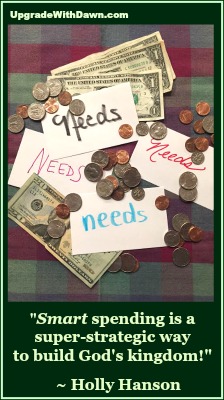
“When you are faced with a charity request, it’s easy to get overwhelmed," Holly says, "but I’ve discovered you can give generously by using your brain and not necessarily your own wallet.”

Were you holding your breath like I (Dawn) was when you first saw the title of this post? I sometimes think, "I wish I had more money to give." I don't think I have much to give. But Holly inspired me. Maybe we need to rethink generosity.

Holly continues . . .

If you are like me, you’ve probably been hit up a lot lately for charitable gifts. It seems there is always a need coming to the forefront.

  • Maybe there’s a family that walks to school in clothes that are in bad shape.
  • Maybe there’s that homeless shelter down the street with a lot of hurting people.
  • Maybe there’s an obvious need you see that someone is too embarrassed to mention.

Should you feel compelled to do anything?

I think the Bible has a very clear answer.

Do not withhold good from those to whom it is due, when it is in your power to do it" (Proverbs 3:27, NASB).

That verse hit me in the gut the first time I read it.

I felt overwhelmed. I certainly couldn’t afford to help EVERY person who had a need.

But then I realized, I’m a money-saver by nature. I didn’t have to pay for it all! It was in my power to help!

I just had to use the gifts God gave me, tap the resources I have access to, and be obedient.

Using a pool of options, I am now able to find solutions for many of the needs I see, without spending a fortune.

1. Inspire others with your vision.

This is my favorite method. When I start to dream big, I tell my friends what I am thinking, and let them join in. By expanding my web of influence, I can sometimes get major donations for my projects, just by dropping a name or two. Sometimes friends will use their own resources to contribute to my project.

I work as a Realtor and recently, I helped sell a divorcing neighbor’s home. He was frustrated about the divorce and didn’t want to move all of his things out, but was willing to give them to my homeless project just because he was inspired by my “pitch.” When I sent him a picture of all of his things being worn and used by the homeless, he said it was the best thing that came out of his divorce.

Incidentally, it also prompted him to ask me why I do things like that, and I was able to tell him about my love for Jesus and the call he has placed on my life.

2. Join as many free sites as you can.

I belong to a “buy nothing” Facebook page that only offers free things to give and take between members. When I see something that would benefit a friend, a young mom, or help the homeless folks I serve, I request it.

I also belong to a local “classifieds” page on Facebook that also frequently advertises free items for pickup.

3. Utilize your consumer connections.

To help my daughter make homeless hygiene packs:

  • We asked her orthodontist and dentist to donate toothbrushes and toothpaste;
  • We hit up some local hotels for travel sized shampoo, conditioner and wet-wipe amenities;
  • We redeemed coupons for free lotions and body wash; and
  • We asked friends to check their cupboards for washcloths, soap, razors, and lip balms.

The kits cost very little this way, but serve a great need.

4. Keep your spending focused.

Are you considering giving a gift to a missionary?

Do you want to thank your pastor’s wife for something?

Are you in need of a professional service?

Upgrade your generosity by allowing those in your church, faith community or circle of friends to be the vendors for your purchase.

By buying from them instead of an outside company, you bless their businesses and help them pay their bills. When they have more money, they can afford to be more generous as well, and the circle gets bigger.  

Smart spending is a super-strategic way to build God’s kingdom!

What specific need can you fill this week, and who can you ask to help you?

Holly Hanson is a veteran Emmy Award-winning journalist who finds her calling in her family motto: “Love God, Serve Others.” Holly has written and produced internationally for Women of Faith, Turning Point Ministries, and locally with KFMB-TV, KFMB-AM and KPBS Radio. She is the founder of the Moms Inc. Ministry and is a licensed California Realtor. She is married and is a mom, step-mom, and step-grandma. Holly is active at Shadow Mountain Community Church, in El Cajon, California, serving with women's ministry, children's ministry, and singing in the Shadow Mountain Choir.

Thursday
Dec152016

Smart Ways to Be Generous

Ellie Kay, America's Family Financial Expert®, is both wise when it comes to finances and compassionate when it comes to generosity. She is the perfect person to share this special Christmas UPGRADE!

"Christmas is the season for giving to others in our family, community, country and world," Ellie says. "What are ways you give to others during the holidays?"

I (Dawn) like the emphasis on giving that stretches us out of our comfort zones and into the compassionate zone, so Ellie's post really speaks to me.

She continues . . .

In the timeless children’s book by Shel Silverstein, The Giving Tree, the story begins, Once there was a tree ... and she loved a little boy."

In this story, the boy would daily come to the tree to eat her apples, swing from her branches, or slide down her trunk ... and the tree was happy.

But as the boy grew older he began to want more from the tree, and the tree kept giving and giving—until she gave her apples, her branches and her trunk in order to provide the boy with wealth, a home and a boat.

But in the end the tree was happy to give.

Jesus said, “For whosoever shall give you a cup of water to drink in my name, because ye belong to Christ, verily I say unto you, he shall not lose his reward” (Matthew 9:41).

I believe that every person can become a generous and savvy giver by looking for ways to reach out to their world and give more.

I also think this is something we can teach our kids and grandkids, too.

1. Donations to the Local Community    

You may be someone who is plugged into a local church that runs kids programs in the summers, provides food and clothing to orphanages, and sends money to victims of natural disasters.

Just as The Giving Tree happily contributed her apples to others, you could give a chance for people in your community to have employment opportunities.

For example, you may want to donate your outdated suits to DressForSuccess so that women who are struggling financially can have proper clothing to get a job interview.

Or, consider giving clothing to a consignment shop that benefits an organization you believe in helping.

Be sure to save tax receipts for all donations to any non-profit organization.

2. Don’t Fund Overhead or Fund Raising

The Giving Tree gave directly to meet the boy’s needs. You may want to do the same and probably do not want your donated dollars funding fat salaries, fancy overhead, or excessive fundraising expenses.

The Better Business Bureau’s (BBB) Wise Giving Alliance offers guidance to donors on making informed giving decisions through their charity evaluations, and the quarterly “Better Business Bureau Wise Giving Guide.”

3. Starting Your Own “Foundation”

If you are fortunate enough to have a large gain from a stock or mutual fund that you have held for over a year, consider using it to become what is essentially your own “foundation.” 

For example, if you own $5,000 worth of stock that you bought years ago for only $1,000, then you can donate the stock by setting up a Fidelity Charitable Gift Fund account. By doing this, you get an immediate $5,000 tax deduction and save having to pay taxes on the $4,000 gain.

In the years to come, as that $5,000 grows, you instruct the company that manages your “foundation” where to donate the proceeds.

Our family worked with military members for 20 years and established a Public Charity to help teach service members financial literacy. In 2016, we gave 15 presentations on ten bases across the country, giving away 3000 financial books and other resources. Heroes at Home 501(c)(3) started as an idea and became an amazing reality. In 2017, we will scale 25 events at 17 bases around the world.

4. Kid Philanthropists

It’s also important to teach our kids the value of philanthropy.

When our kids were growing up, they helped us gather and deliver food items for a local food pantry. They helped purchase modest toys and they dropped the gifts into the box at the “Toys for Tots” program.

Another option is to allow your children to manage a donation in a predetermined amount that you set aside for the purpose of teaching them to give. They get to research a variety of non-profit organizations and decide which one will receive their donation. Then donate the amount in your child’s name.

You get the tax benefit, your child gets the thank you note—you BOTH become Giving Trees.

Ten Priceless Gifts You Can Give for Free!

  • Fix broken fences by mending a quarrel.
  • Seek out friend you haven’t seen in a while or who has been forgotten.
  • Hug someone and whisper, “I love you so.”
  • Be patient with an angry person.
  • Express gratitude to someone in your world.
  • Make a child smile.
  • Find the time to keep a promise.
  • Make or bake something for someone else—anonymously.
  • Take a walk with a friend.
  • Smile.  Laugh a little.  Laugh a lot.

How will you give during this holiday season?

Ellie Kay is the best-selling author of fifteen books including Lean Body, Fat Wallet, and Heroes at Home. She is a Toastmaster Accredited Speaker as well as a popular international speaker and media veteran who has given over1,200 media interviews including appearances on ABC, CNBC, CNN and Fox News. As a popular columnist, she writes for six national magazines and has been a Subject Matter Expert for the Wall Street Journal, New York Times and Washington Post. Currently, Ellie provides financial education to military members through her “Heroes at Home Financial Event” sponsored for USAA. Ellie is married to LTC Bob Kay and they have seven children.

Monday
Jul042016

Heroes at Home - Fighting for Financial Freedom

Today, we have a special guest blogger, Ellie Kay, who is the founder of Heroes at Home, a 501(c)(3) dedicated to helping military families and all Americans find financial freedom. 

"How would you like to live debt free?" Ellie asks. "Even as we celebrate Independence Day and the men and women who keep our nation stay free, we also can become financially free."

I (Dawn) believe there are many kinds of freedom we can experience as members of the family of God. Financial freedom is one kind of freedom that can affect your family, career and even how you give to ministy! God wants you to be a wise, intentional and cheerful giver (Proverbs 21:20a; 2 Corinthians 9:7), and one way to do that is to operate out of financial freedom!

Ellie continues . . .

In my work helping service members with financial readiness, there are tips that apply to everyone.

1. Credit Credibility

No matter what your financial picture is, it’s critical for every person to improve her own FICO (Fair Isaac Credit Scores). These scores determine not only the APR you pay on a home or car loan, but they also impact auto insurance premiums, whether you’ll get the promotion or the job (many employers check FICOS), whether you pay a security deposit for utilities, and much more.

You can go to Credit.com to check your score and they’ll even give you specific ways to improve each area of your credit score.

You can improve your FICO in three easy steps:

  • Pay early – Set up automatic payments online so you will never be late.
  • Pay More - Add $5 to $10 more than the minimum balance that is due; this indicates you are paying down debt.
  • Pay Proportionally – Also known as credit utilization—make sure you don’t have more than 30% of the available credit charged on any one card at any time. For example, a card with a $5000 limit should never have more than $1500 charged.

2. Savings Savvy

It only takes 15 minutes to save hundreds of dollars! Once you save money in one area, use those funds to pay down consumer debt or to build up a savings account.

  • Auto Insurance – Once a year, compare policies by getting a variety of quotes. Take the cheaper price back to your existing provider and tell them you will switch companies unless they can match the price. (Be sure to check out quotes from USAA.com if you are military and qualify to be a member.)
  • RetailMeNot – If you have a smart phone, download the RetailMeNot app or bookmark it on your computer. This is a code site that offers 400,000 coupon codes at any given time. Just enter the store’s name and you’ll see all the codes to get the better prices. Use this on entertainment, travel, electronics and any kind of online shopping or in the mall.
  • CouponMom.com – I was one of the original extreme couponers and it’s served me well all these years. If you go to this site, she’s done all the work for you and will tell you what is on sale in your neighborhood, what codes are available, what coupons are out for the item and which stores double coupons. I calculated that over the course of twenty years, I saved our family over 160K!  

3. Debt Deal Dilemma

With a slow economy comes an influx of those who want to "help" prepare you for the worse by consolidating your debt. However, most “for profit” debt-counseling companies charge a hefty fee for their services, which is usually tacked onto your debt load.

Instead, go to the National Consumer Credit Counseling Service at www.nfcc.org and use their free services.

4. Budget Baby

If you don't have a budget—as part of your lifestyle—then yesterday was the day to start! Set one up with online budgeting tools, found at mint.

The problem for a lot of families is not having a budget, it’s sticking to a budget.

Set up a “budget date” once a month with your spouse to revisit how the plan is working.

This kind of regular accountability works as well in finances as it does in Weight Watchers. When you know there will be someone asking you why you bought that purple mohair sweater for $198, you’re less likely to give into the impulse to go off budget.

Can you celebrate your "Financial Freedom" today? If not, which of Ellie's tips might help you claim your independence?

A special JULY 4th note:

During this time of the year, be sure to thank those heroes at Heroes at Home ... thank them for their service. [For more information on where Ellie Kay’s Heroes at Home is visiting next, explore their website at HeroesAtHome.org.]

Ellie Kay is the best-selling author of fifteen books including Lean Body, Fat Wallet, and Heroes at Home. She is a Toastmaster Accredited Speaker as well as a popular international speaker and media veteran who has given over1,200 media interviews including appearances on ABC, CNBC, CNN and Fox News. As a popular columnist, she writes for six national magazines and has been a Subject Matter Expert for the Wall Street Journal, New York Times and Washington Post. Currently, Ellie provides financial education to military members through her “Heroes at Home Financial Event” sponsored for USAA. Ellie is married to LTC Bob Kay and they have seven children. 

Graphic adapted, courtesy of Morguefile.

Thursday
May122016

Upgrade Your Finances: The Family Road Trip

Ellie Kay is known as “America’s Family Financial Expert” ® and in this Financial UPGRADE gives us some timely information on taking the family on a road trip this year.

"I remember my dad stuffing all of us kids in the back of a VW bug and traveling from Texas to Indiana, making about 600 miles per day," Ellie says. "It was a daring adventure!"

I (Dawn) traveled a lot too, in a military family; and I can attest that Ellie's financial tips are all helpful and wise!

Ellie continues . . .

That traveling tradition continued with my own military family as we took time in the summer to carve our own road trip.

Here are some ideas that will make your family trip a lot more fun and affordable.

1. Begin With Prayer

My husband, Bob, and I liked to begin our family vacation planning process with prayer.

James 1:5 says that if any of us lack wisdom, we can ask God. Well, we asked Him early and often and He answered! We feel that He gave us additional insight as to what would be best for our family and our budget.

Then, before each day’s drive, Bob had the whole Suburban full of kids bow their heads and he prayed for safety, for unity and for a spirit of fun.

2. Healthy Eats and Treats

One of the greatest expenses while traveling is for food on the road. Not only does it get pricey, but these purchases can also take a toll on health by eating fast food on the road.

When we traveled, we packed a lunch for the first day on the road and stopped at roadside parks. It’s easy to plan these stops by locating parks through the Roadtrippers app.

To save money on snacks, pack some healthy options in individual bags for each family member – such as carrots, grapes, cherries, pretzels or trail mix. Bring along extra snack-size baggies so you can split other treats you buy on the road – such as fresh popcorn, fruit or beef jerky from a roadside store.

3. Busy Hands and Happy Hearts

One of our main challenges as a family was keeping the kids occupied, and this is the number one concern I hear from parents.

Older children can use a tablet or game to stay busy, and everyone enjoys movies on the way. But even these options can lead to inevitable boredom as kids start to get restless. I think this is where creativity comes into play.

When we had a long trip (or a military move), I shopped ahead of time for small games, books, activity puzzles, little toys and other trinkets I knew they would like. Then I’d wrap these “surprises” in gift paper and put each child’s name on it. At the top of every hour, we would give them their individual present. You can also go to Travelforkids to find other alternatives.

4. A Place to Stay 

There are creative ways to save money on a place to stay on the family road trip. You can go to vrbo.com to find vacation rentals by owners.

Suite hotels that offer extra rooms are also an option such as the ones found at hotels.com, orbitz.com or cheaphotels.com.

Another option is to try a family camp. Google “YMCA family camps” to find one that meets your needs. You can enjoy a cabin, horseback riding, canoeing, and other great family activities for 40% off the cost of a conventional resort area. 

5. Food and Entertainment

Be sure you make use of Yelp to find the best restaurant at the best prices and bonuses such as free appetizers or desserts.

I also recommend entertainment.com where you enter the zip code of where you will be traveling in order to preview their entertainment books for that destination. Be sure you download the app RetailMeNot to find codes on everything you’ll need on your vacation, whether you are shopping for souvenirs in a store or eating at a restaurant.

At restaurant.com you enter the zip code to get gift certificates for half price and while you’re there, see if they have any sales. I recently bought $25 gift certificates at that site for only $4 when I applied a coupon code.

6. Save on Gas

AAA’s Fuel Cost Calculator helps plot the most efficient route. Just enter the year, make and model of your car and it will compute what you’ll spend on gas.

Get the GasBuddy app and find the cheapest price for gas along the way.

We also use the Waze app to find real time road conditions, the most efficient route, and the best gas prices along the way. On more than one occasion, it has saved us 30-45 minutes by avoiding a crash or slow down.

7. Prayer of Thanks

Begin and end your family road trip with prayer, thanking God for his protection, wisdom and safety.

Some of the best family memories you may ever have can be found on the road if you purpose in your hearts to make them with the ones you love.

What kind of a family road trip will you have this year?

Ellie Kay is the best-selling author of fifteen books including Lean Body, Fat Wallet, and Heroes at Home. She is a Toastmaster Accredited Speaker as well as a popular international speaker and media veteran who has given over1,200 media interviews including appearances on ABC, CNBC, CNN and Fox News. As a popular columnist, she writes for six national magazines and has been a Subject Matter Expert for the Wall Street Journal, New York Times and Washington Post. Currently, Ellie provides financial education to military members through her “Heroes at Home Financial Event” sponsored for USAA. Ellie is married to LTC Bob Kay and they have seven children.

Graphic of picnic table, courtesy of Morguefile.

Tuesday
Jan052016

A Fresh Start for Your Finances

Do your finances need a fresh start in the New Year? Ellie Kay, known as “America’s Family Financial Expert”®, is sharing a timely Financial UPGRADE today.

“After the holidays, most Americans face some pretty hefty credit card bills in January,” Ellie says. “In fact, it will take until May of this year to pay off the new credit card debt from the holidays and this doesn’t even include what debt may have already been on the card.”

Been there, done that, and I (Dawn) have “financial scars” to prove it! I had to learn some wisdom from the Bible and practice good stewardship. (*See end of this post.)

Ellie continues . . .

It may seem like a game to juggle debt, but it’s one that you can win if you are determined to get a fresh start. Through the power of prayer and a desire to follow God’s wisdom in your finances, you can get the fresh start you desire.

As a child, I loved Monopoly®. I pretended all the play money was real—and mine! Sometimes we view real money as if it were play money.

When faced with the hard facts about their finances, many families go through five different stages—similar to the stages of grief:  shock, denial, depression, anger and acceptance. Your fresh start is just on the other side of this journey.

1. Shock

Shock depends on what you believed in the beginning. For example, if a family already knew their total consumer debt load (credit cards, car payments, furniture loans, etc.) was around 40K, they would only be mildly shocked at how 40K in debt looks on paper. But another couple may think they are only a couple of years away from being debt free and they discover they are twenty years away. That kind of a severe shock can take time to absorb. 

Use shock as a starting point to make better decisions. There are excellent budgeting and debt repayment tools at my website. I absolutely love the free Mint app.

2. Denial

Denial is not a river in Egypt.  It is the most common stage in financial recovery. Continual denial makes people more likely to succumb to scams such as email phishing schemes or “Payroll Loans.” Once you face denial, you can overcome it.

Several red flags of financial denial include:

  • Paying late fees
  • Missing Payments
  • Balancing or staggering bills, or
  • A perpetual lack of cash.

Oftentimes, this stage will find you stuck—you are unable to reduce your debt, or if you do, you are soon back into debt again. There’s hope when you begin to follow God’s principles of good stewardship.

3. Depression

A series of money problems that press in can bring on financial depression characterized by:

  • Lack of concentration,
  • Insomnia,
  • Guilt, or
  • Hopelessness.

Consumer Credit Counseling Services is a non-profit organization specializing in debt reduction and financial education. A counselor can get credit card interest rates lowered, payments deferred, and help develop a plan to emerge from the debt depression cycle.

4. Anger

The anger stage is sometimes scary. Anger can be manifested through a wide range of emotions at a high intensity level. It can be as mild as being a grump or as severe as significant arguments.

At this point, some people even get mad at God and blame Him.

When the number one issue cited in divorce today is “finances,” it’s easy to see how couples in this stage end up in the “debtor’s prison” of divorce court.

Refuse to put your anger on someone else. Talk with someone—professionals, your pastor or church counselor. It helps diffuse feelings.   

5. Acceptance

You’ll know you’ve reached this final stage, acceptance, when at least some of these elements are evident:

  • Change – You discover what you need to change and you’re willing to make changes.
  • Responsibility – You’ve stopped blaming someone or something else and have accepted responsibility for what you and your spouse did to contribute to your current financial status. 
  • Accountability – Besides mutual accountability, couples agree to make themselves accountable to another couple or financial counselor. 
  • Hotspots –You’ve identified hotspots where you’ve fallen short financially, and you purpose to avoid them through prayer and God’s help. 
  • Patience – You have hope. You are more tolerant of your own mistakes and have decided to learn from them. 

Invite God into the equation. Through the power found in a relationship with Jesus, we can be more than conquers, even when it comes to our finances. Take it a day at a time and, in the future, you will be on the other side of this problem.

Then it will be your time to help someone else.

What will you do to get your financial fresh start in the New Year?

Ellie Kay has been a regular expert on national television with ABC NEWS NOW’s Money Matters and Good Money shows. Ellie is also a national radio commentator, a frequent media guest on Fox News, and CNBC, a popular international speaker, and the best-selling author of fifteen books including Lean Body, Fat Wallet (Thomas Nelson, 2014).

* A few scriptures to apply wisdom from the Bible regarding finances (Proverbs 15:22; 21:5; 22:7; 27:12); and stewardship (Psalm 24:1a; Matthew 6:21; Luke 12:42-44; Romans 14:12).