




Member of AWSA

  Info about AWSA


[Bios on Partners Page]

PARTNERS:

Lina AbuJamra

Sue Badeau

Dianne Barker

Twila Belk

Gail Bones

Harriet Bouchillon

Mary Carver

Pamela Christian

Lisa Copen

Erin Davis

Diane Dean

Deb DeArmond

Kelly DeChant

Danna Demetre

Melissa Edgington

Debbi Eggleston

Pat Ennis

Morgan Farr

Pam Farrel

Liz Cowen Furman

Gail Goolsby

Sheila Gregoire

Doreen Hanna

Holly Hanson

Becky Harling

Debbie Harris

Nali Hilderman

Cathy Horning

Kathy Howard

Mary James

Priscilla Jenson

Lane P. Jordan

Rebecca Jordan

Ellie Kay

Maria Keckler

Sylvia Lange

Debby Lennick

Peggy Leslie

Kathi Lipp

Kolleen Lucariello

Kathi Macias

Paula Marsteller

Melissa Mashburn

Dianne Matthews

Cindi McMenamin

Elaine W. Miller

Kathy Collard Miller

Lynn Mosher

Karen O'Connor

Yvonne Ortega

Arlene Pellicane

Ava Pennington

Laura Petherbridge

Gail Purath

Marcia Ramsland

Kaley Rhea

Rhonda Rhea

Vonda Rhodes

Cynthia Ruchti

Julie Sanders

Judy Scharfenberg

Deedra Scherm

Laurel Shaler

Joanie Shawhan

Stephanie Shott

Poppy Smith

Susan K. Stewart

Stacie Stoelting

Jill Swanson

Janet Thompson

Janice Thompson

Teri Thompson

Brittany Van Ryn

Elizabeth Van Tassel

Leslie Vernick

Laurie Wallin

Julie Watson

Joan C. Webb

Cherri Williamson

Kathy C. Willis

Debbie W. Wilson

Nancy DeMoss Wolgemuth

Jamie Wood

   and Founder:

   Dawn Wilson


Entries in Friendships (6)

Thursday
Jul282016

Invest in Your Prime Relationships - Part 2

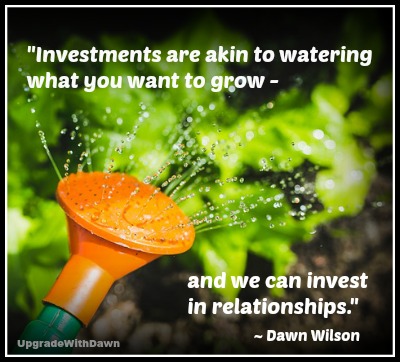
What are your "Prime Relationships"? In the last UPGRADE post, Dawn asked this question and said we can all invest more in our prime relationships. First we invest in our relationship with the Lord, and then we invest in ourselves (so we will be strong and ready to serve God).

There are three other priority relationships, and investments in each of them can make a huge difference in OUR lives - and in THEIRS!

[Note: for a more detailed version of this post with scriptures, see my other blog: Heart Choices Today.]

          Investment #3: INVEST in YOUR SPOUSE

If you are married, this is your prime relationship after your relationship with God. 

There are so many ways to invest in a spouse. Here are only a few:

1. Communicate Love and Appreciation.

2. Develop a Partnership.

  • Don't try to go it alone. You are "heirs of the grace of life" (1 Peter 3:7). 
  • Become friendly warriors together in the battle against temptation.
  • Seek the Lord together for His purposes in your home.
  • Ask, "How can I help?"

3. Value Gifts and Skills.

  • Discover your Partner's spiritual gifts
  • Notice your partner's skills. 
  • Help cultivate these gifts.
  • Appreciate and value your partner in public.

4. Fulfill Your Role.

  • Husbands can protect, provide for, lead with love and wisdom; respond in gentle, loving, kind and respectful ways to honor their wives; express appropriate public praise; and study their wives and help them become the women God purposed them to be.
  • Wives can support and encourage his leadership in the home; appreciate their work; manage their home well; show respect; trust God with her highest hopes for her man; and understand and appreciate her husband's God-given sexual needs.

          Investment #4: INVEST in YOUR CHILDREN

After your spouse, your children are the next priority investment—not the other way around.

1. Love Them Unconditionally.

  • Don't expect perfection. Your kids are going to mess up. They're kids!
  • Express your love privately and publicly.
  • Help them see the value of "family." 

2. Teach Them to Seek the Lord.

  • Help them see their need for the Lord.
  • Don't give answers too quickly. Challenge them to search the scripture.
  • Teach them how to pray.
  • Promote a godly legacy.

3. Discipline Wisely.

  • Distinguish between immaturity and defiance. 
  • Discipline quickly and wisely. 
  • Encourage proper respect.
  • Encourage growth and change.

4. Model Good Character.

  • Model behavior you want repeated. .
  • Reward good behavior.
  • Train them to be responsible.
  • Help them cultivate godly friendships.

5. Encourage Creative Growth.

  • Don't overschedule their lives.
  • Encourage their creativity.
  • Help them stretch.
  • Give them space to pursue their dreams.

          Investment #5: INVEST in YOUR FRIENDSHIPS

Good friends don't just happen. Friendship requires intentional investment.

1. Practice Committed Encouragement.

  • Be intentional.
  • Practice loyalty.
  • Be generous.
  • Build into their lives. .

2. Listen More and Better.

  • Listen to their heart.
  • Listen with compassion.
  • Ask questions. Seek to understand so you can encourage.

3. Challenge Greater Growth.

  • Go deeper, with purpose. If youi've developed the kind of friendship that can bear the weight of accountability, ask deeper questions that challenge your friend to greater growth.
  • Come alongside.
  • Pray for your friend regularly.

Can you apply any of these strategies to your own prime relationships? Which one would make the biggest difference today?

Note: There was a lot of territory covered in these two posts, and by all means, it does not cover everything that will encourage wise investments in your relationships. I encourage you to discover more as you "read the manual" for all relationships: the Word of God.

Dawn Wilson, founder and President of Heart Choices Today, is a speaker and author, and the creator of three blogs: Heart Choices Today, LOL with God (with Pam Farrel), and Upgrade with Dawn. She is contracted researcher for Revive Our Hearts. She and her husband Bob have two grown, married sons, three granddaughters and a rascally maltipoo, Roscoe.



 

Tuesday
Nov172015

How to Make Friends in New Seasons

I've watched from afar as Julie Sanders made a difficult transition to a new state and new role, and I've admired her willingness to step into this new season of life. In this Friendship UPGRADE, she shares encouraging words for all of us seeking new friends.

"When we’re the unknown new girl, we need friends," Julie says. "How do we make a new life better by making a new friend?"

With a dad in the military, I (Dawn) often had to make new friends in new places. It's not often easy. Julie gives us helpful tips.

Julie continues . . . 

Friendships ebb and flow with life transitions like shifts in marital status, geography and employment. Change can thrust relationships into upheaval and leave us feeling friendless.

Whether firmly rooted in your hometown or freshly planted in a new neighborhood, you may find yourself needing a friend.

God fashioned us to walk through life with the fellowship of friendship.

Multiple translations of Proverbs 18:24 offers insight to improve relational health and help us find friends when we need them most.

A man of many companions may come to ruin, but there is a friend who sticks closer than a brother. (ESV)

A man that hath friends must shew himself friendly: and there is a friend that sticketh closer than a brother. (KJV)

Suggestions for making new friends in new seasons of life:

1. Focus on a FEW.

 When events like the loss of a loved one or a major move finally crash on shore and retreat, silence follows. A longing for the familiar or a desire to quiet the loneliness may result in temptation to gather a crowd of people around us.

As ruinous as complete withdrawal, surrounding ourselves with a swarm of companions may lead to a layer of life where we are barely known and marginally valued. Instead of jumping into the rushing rapids of relationships, Proverbs cautions that having too many friends is dangerous. Since we are fashioned to walk through life with the fellowship of friends, we’re more likely to find true friendship in a few.

Scheduling coffee or lunch with every new, available woman we meet at church, in the restroom, and at the grocery store is tempting.

Instead of letting the tide take you away to avoid the tension of transition, ask God to give you a few places to invest.

2. Force yourself to be FRIENDLY.

If you’re not eagerly noting contact information when a friendly person makes eye contact, you might be the lonely woman tempted to withdraw. Solitude might feel like the safer sanctuary. After all, you might have dragged painful baggage into this season of life. Isolation might feel easier than finding friendship.

Solitude has a place in life change, but forging new relationships requires a decision to be friendly, even when we might not feel like it. 

  • Make eye contact.
  • Smile first.
  • Introduce yourself.
  • Talk to people of different ages.
  • Keep an open mind and heart. God wants us to find the fellowship of friendship.

3. Don’t Forget your BEST FRIEND.

For whatever reason, you find yourself in need of a new friend. It’s a good thing to hope and pray and look for.

When you find that longed for companion, she will be delightfully imperfect, unable to meet all your expectations and beautifully flawed like you.

She will not make your life complete, and that’s okay. Someone else is the perfect friend.

No one takes the place of Jesus. Times of loneliness and longing lead us back to remembering the sweet security of friendship with Jesus. No matter what season or circumstance, He will stay with us and be our BFF.

As you show yourself friendly, focus on a few relationships and experience the friendship of God in a fresh way. God fashioned us to walk through life with the fellowship of friendship.

Look around your life. Who is a potential new friend given to you by the sweetest Friend of all?

Julie Sanders—as an empty nester and new girl in town—is making friends around her new home in the Inland Northwest. Her local and global ministry to women has given her a passion for the issue of human trafficking.  She believes life is better when the lives of women are interwoven. Visit Julie’s blog, “Come Have a Peace.”

Graphic Adapted, Image courtesy of imagerymajestic at FreeDigitalPhotos.net.

Tuesday
Apr212015

A Friendship Wake-up Call

Sylvia Lange is a talented, compassionate singer and speaker. But she's also the kind of woman you'd want to call "friend." In this Relationship UPGRADE, she shares her journey into real friendships.

"Years ago over coffee," Sylvia said, "a friend slapped me in the face. In public. Well, maybe not a physical slap but she sure got my attention when she quietly murmured, 'You know, it isn’t always about you.'”

Talk about a wake-up call! I (Dawn) don't know how I would have responded. But I'm glad Sylvia took the high road and responded Godward so she can give us biblical insight.  

Sylvia continues . . .  

No one had ever spoken to me like that before.  My initial indignation quickly morphed into embarrassment as I wondered who else thinks the same thing?

A review of my roster of friends revealed that the majority of my social connections were pretty superficial. With few exceptions, I had surrounded myself with people I could either control or from whom I could get something.

I had very few equals and certainly, no true heart friend. I needed an overhaul.

Someone once said in order to have a good friend you must first be a good friend. I soon realized I really didn’t know how, so starting on that painful day, I got busy.

I began spending time with authentic Christians who practiced a lifestyle of service. They helped me understand that although I am “made in the image of God,” I am no better than anyone else. In fact, I needed to just be a “worker among workers.”

I began to create some space between myself and people who didn’t share my core values. 

"One who has unreliable friends soon comes to ruin, but there is a friend who sticks closer than a sister" (Proverbs 18:24).

I zeroed in on those who believed in me, recognizing that anyone functions at their best when they have their own private cheerleading squad.

I also started to emulate people with strong friendships of their own. Although many actions were initially awkward, over time, behaviors that were once foreign became automatic and the impact on my relationships was immeasurable.

That was twenty-five years ago. And although I will always be learning, I have picked up a few truths:

1. Real friendship isn’t about you.  

Let’s face it: it is rarely convenient to truly attend to someone at their level of need . . . not on the level that’s convenient for us.

True, deep friendship requires intentional effort, can cramp our comfort, impinge on our time, and sometimes even cost money . . . but the payoff is priceless. 

Today, my friendship quiver is full of a variety of unselfish, loving people who put their money where their mouth is.

2. Friendship plays to each other’s strengths and celebrates its differences. 

My long-time friend and ministry partner Billye and I recognize we have no natural chemistry and agree that our friendship has been the most challenging either of us has ever had. In our early years we often brought out the worst in each other, but over time, we have learned to value our differences and recognize that together, we’re stronger than on our own.

3. Friendship leaves its ego at the door.  

 My good intentions’ only go so far if I don’t notice how my friend needs to be communicated with, served and loved, regardless of how I need to be communicated with, served, and loved.

4. Friendship is trustworthy. 

A trustworthy friend keeps her promises, is reliable and would never do anything that would compromise the security of her friend, no matter how she might gain otherwise. 

What is your definition of real friendship? And to what lengths should a person go to be a real friend?

Sylvia Lange, a popular women's ministries speaker both on her own and with her duo Crimson Bridge, is  known for her infectious candor that invites listeners to know more about the God to Whom she owes her life. Whether blogging, speaking for a women's ministries event or sharing from one of her five albums, she speaks with Spirit-propelled authority to those who don’t yet know Christ and those who have forgotten Who He is. To book Sylvia or purchase her music, visit www.sylvialange.com. Sylvia is also committed to Compassion International, an outreach to starving, diseased children in the 3rd World.

Graphic adapted, Image courtesy of Serge Bertasius Photography at FreeDigitalPhotos.net.

Tuesday
Mar032015

Friendship Praying

Rhonda Rhea is known for her humor, but I also appreciate her practical leadership and encouragement. In this Relationship UPGRADE, she touches on one important way to strengthen our friendships.

“Ever feel lonely? You’re ‘not alone,’ as it were, in feeling alone,” Rhonda said. “It’s amazing how so many can know a gazillion people—yet still experience a devastating loneliness. Prayer can change that.”

I (Dawn) know the Word of God encourages us to make “supplication” for “all the saints” (Ephesians 6:18) and “for all people” (1 Timothy 2:1), and this certainly applies to praying for our friends. So many scriptures about prayer can be applied to our friendships, and especially to our brothers and sisters in Christ. Try it!

Rhonda continues . . .

The truth is, we need each other.

We need to pray for each other. We need to pray for our friends!

Here are some “ifs” for friendship praying:

1. If you’re experience smothering loneliness:

  • Ask the Lord to send you a “breath of fresh air” kind of friend.
  • Ask Him to help you become someone else’s breath of fresh air as well.

2. If you’ve been wounded in a friendship:

  • Ask the Lord to give you the ability to forgive and to help you move forward and trust again.

3. If you’re not already:

Ask the Lord to give you courage to become proactive in making and maintaining friendships.

4. If you have at least one close friend:

  • Thank the Lord for the amazing blessing she is.
  • Ask Him to make you a blessing to her.
  • Ask Him to give each of you wisdom in honoring Him through the friendship.

Which of these “if” prayers could make the biggest difference in your friendships today?

Rhonda Rhea is a humor columnist, radio personality, speaker and author of 10 books, including How Many Lightbulbs Does It Take to Change a Person?, Espresso Your Faith - 30 Shots of God's Word to Wake You Up, and a book designed to encourage Pastor's Wives (P-Dubs): Join the Insanity. Rhonda, a sunny pastor's wife, lives near St. Louis and is "Mom" to five grown children. Find out more at www.RhondaRhea.com.

Post adapted from Rhonda’s book, Join the Insanity: Crazy-Fun Life in the Pastors' Wives Club.

Graphic adapted—Image courtesy of Witthaya Phonsawat at FreeDigitalPhotos.net.

Tuesday
Feb042014

Reach Out to Your Friends

Lane Jordan, a professional life coach, offers helpful counsel for women who want an organized life. In this post, she has good advice for those of us who want to UPGRADE our friendships.

I am very loyal to my friends, and I want to be there for them as much as possible,” Lane said.

I think most of us want to “be there” for friends … but how?

Lane continues …

Friends are people who also have illnesses, family troubles and hardships. We need to be available to stretch out our hands to them in their need.

If you don’t have the time in your life now to help a friend, then maybe you are doing too much.

What would you change in your life?

1. If friends are sick, be ready to help drive them to the doctor or pick up something for them at the store.

Keep a meal frozen in your freezer so you will have one to give away quickly if a friend is in need. Be willing to babysit their children.

2. Be available to talk to them when they need you, in person or by phone.

Try to stop what you are doing and be sure to listen well. Many times all a friend needs is someone to listen and to care. Have empathy—put yourself in their shoes. Offer encouragement. Don’t nag or argue.

3. E-mail them a short message or a text so they know you care.

This is a way to keep in touch without intruding or bothering them.

4. Accept your friends as they are.

Praise their accomplishments and never be jealous of them. Be forgiving. And if you need to, don’t be afraid to say you’re sorry.

5. Always keep promises and secrets.

A real friend never gossips, is discreet and confidential.

6. Speak words of hope, grace and truth, and demonstrate faith.

A friend also prays for and with her friends and commits to prayer intercession for them.

7. Be there when a friend loses a loved one.

Sometimes we don’t know what to say when our friends are grieving. But a quick visit with a meal, visiting just to be available, sending a card or letter that shares how special their loved one was, and even remembering the birthday of the deceased are extremely helpful and loving gestures.

Grieving is an ongoing process that requires continuing help and support. “Bear one another’s burdens” (Galatians 6:2) is a verse we need to remember.

Friends are healthy! Having a community of friends around you will keep you healthier and will give you more joy in your life. Do all you can to cultivate friendships.

Which of these points most encourages you to UPGRADE your friendships … to grow in your relationships?

Lane P. Jordan is an author, national speaker and seminar leader for Christian organizations, a certified professional life coach with the American Association of Christian Counselors, and has served as Associate Producer for the weekly television program “In Touch with Dr. Charles Stanley.” Explore her website!

Note: This post is adapted from pages 42-43 in Lane’s book, 12 Steps to Becoming a More Organized Woman. Graphic in text is adapted from photo by Stuart Miles, freedigitalphotos.net.