




Member of AWSA

  Info about AWSA


[Bios on Partners Page]

PARTNERS:

Lina AbuJamra

Sue Badeau

Dianne Barker

Twila Belk

Gail Bones

Harriet Bouchillon

Mary Carver

Pamela Christian

Lisa Copen

Erin Davis

Diane Dean

Deb DeArmond

Kelly DeChant

Danna Demetre

Melissa Edgington

Debbi Eggleston

Pat Ennis

Morgan Farr

Pam Farrel

Liz Cowen Furman

Gail Goolsby

Sheila Gregoire

Doreen Hanna

Holly Hanson

Becky Harling

Debbie Harris

Nali Hilderman

Cathy Horning

Kathy Howard

Mary James

Priscilla Jenson

Lane P. Jordan

Rebecca Jordan

Ellie Kay

Maria Keckler

Sylvia Lange

Debby Lennick

Peggy Leslie

Kathi Lipp

Kolleen Lucariello

Kathi Macias

Paula Marsteller

Melissa Mashburn

Dianne Matthews

Cindi McMenamin

Elaine W. Miller

Kathy Collard Miller

Lynn Mosher

Karen O'Connor

Yvonne Ortega

Arlene Pellicane

Ava Pennington

Laura Petherbridge

Gail Purath

Marcia Ramsland

Kaley Rhea

Rhonda Rhea

Vonda Rhodes

Cynthia Ruchti

Julie Sanders

Judy Scharfenberg

Deedra Scherm

Laurel Shaler

Joanie Shawhan

Stephanie Shott

Poppy Smith

Susan K. Stewart

Stacie Stoelting

Jill Swanson

Janet Thompson

Janice Thompson

Teri Thompson

Brittany Van Ryn

Elizabeth Van Tassel

Leslie Vernick

Laurie Wallin

Julie Watson

Joan C. Webb

Cherri Williamson

Kathy C. Willis

Debbie W. Wilson

Nancy DeMoss Wolgemuth

Jamie Wood

   and Founder:

   Dawn Wilson


Entries in Communication (5)

Tuesday
Oct112016

10 Ways to Foster Gracious Speech

Kathy Howard, who sometimes calls herself a "confused southerner," is not at all confused about the truth of scripture. In this Communication UPGRADE, she encourages us to use our words wisely, with gracious speech.

“Our words have the power to build up or tear down," Kathy says, "but gracious speech has been an area of struggle for me.”

I (Dawn) have never had a serious problem with using words to tear other down, but it took me a while to learn how to effectively use words to encourage others. I'm glad Kathy addresses both issues!

Kathy continues . . .

Years ago, when our young family lived in Wyoming, my parents regularly came all the way from Louisiana to visit us. Just before one such visit, we purchased a dining table and chairs for a long-empty breakfast area. I couldn’t wait to show off the new furniture.

The first time we gathered around the table, Mom pulled out her chair and sat. As she scooted forward, a leg of the chair caught in the groove between two tiles. The leg snapped off, the chair tilted, and my mother hit the floor. HARD!

My immediate reaction was not words of grace.

“You broke my chair!” is what came out of my mouth.

Not, “Are you alright?!” or “Let me help you!”

My mother looked so hurt. Not physically; the tumble wasn’t bad. But I terribly hurt her feelings.

My quick words revealed what was in my heart – I cared far too much about material things. My first thought had been for the chair, not my mother. And my thoughtless words wounded her.

The apostle Paul knew our words have the power to build up or tear down. In his letter to the Christians in Ephesus, he tells them – and us – exactly what effect our speech should and should not have on others.

"Let no corrupt communication proceed out of your mouth, but that which is good to the use of edifying, that it may minister grace unto the hearers" (Ephesians 4:29, KJV).

First, our speech should not “corrupt.”

Far more than curse words, corrupt speech is graceless speech.

It tears down, deflates. Whenever we speak corrupt words to our spouse, our child, our coworker, or friend, they deflate like a beach ball full of holes.

Any words not wholesome or beneficial tear them down emotionally and spiritually. Little by little the air goes out. Sadly, I’ve seen my own words have that effect on other people.

Second, our speech should “benefit” or “minister grace” to others.

Like air blown into a deflated beach ball, good and edifying words will encourage and build up an individual, helping them to reach their full potential in Christ.

Even when we long for our words to give grace to others, sometimes things break down between our desire and the words that flow out of our mouths.

Sadly, our words will betray us, revealing the junk we have hidden in our hearts. Things like insecurity, hurt, unresolved anger, selfishness and pride produce words that wound, tear down and corrupt.

Would you like your words to consistently encourage, build up, and give grace to others? Here are ten things we can do to foster this “gracious” overflow:

  1. Regularly reflect on the unbounded grace God has lavished on us.
  2. Remember God will hold us accountable for every word we speak (Matthew 12:36).
  3. Constantly check our hearts for sinful attitudes and motivations. (See Matthew12:34-36.)
  4. Ask God to heal old hurts, soothe anger, and humble pride.
  5. Refuse to use "corrupt" speech – any words that wound, discourage, or tear down.
  6. Commit to using "good" words - kind and gracious words that build up and encourage.
  7. Find something positive with which to begin and end every conversation.
  8. Don't waste time talking about things that can't be changed.
  9. Focus on the other person. Ask questions about them and their feelings.
  10. Exercise self-control. Sometimes the most gracious thing to say is nothing.

With God’s grace flowing through us, our words can be tools of grace God uses to build up, encourage, and edify.

When was the last time your noticed the power of your words to either wound of give grace? What was the result?

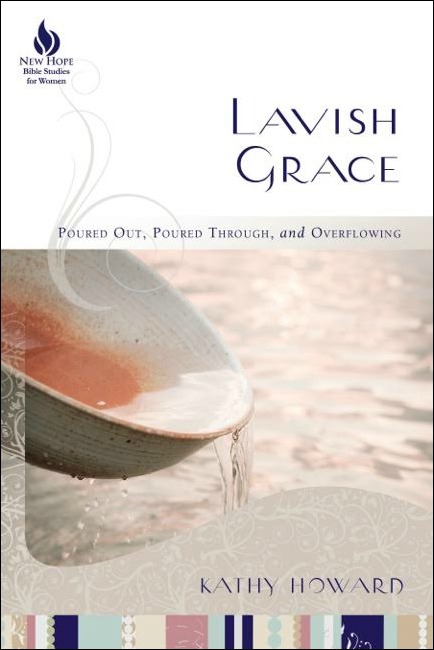
Kathy Howard helps women live an unshakeable faith for life no matter the circumstances. This post is adapted from her new Bible study Lavish Grace: Poured Out, Poured Through, and Overflowing. Lavish Grace is a 9-week journey with the apostle Paul that helps readers discover God’s abundant grace for their daily lives and relationships. You can find out more about Kathy and her speaking and writing, or find free resources at her website
Heart graphic is adapted, courtesy of Morguefile.

Thursday
Sep152016

3 Ways to Make Nice in Your Marriage

Elaine W. Miller wrote a book with a funny title, We all Married Idiots. In this Marriage UPGRADE, she gives a little insight into why that’s true!

“Why are we such idiots?” Elaine said. “We smile, open doors, and run to rescue strangers. In the workplace we hold our tempers, fearing a job loss if we don’t. Yet when we enter our homes, we frown, slam doors and lose our tempers with no fear of the consequences.”

Oh ugh. I (Dawn) am guilty as charged. Why do we hurt the ones we love?

Elaine continues . . .

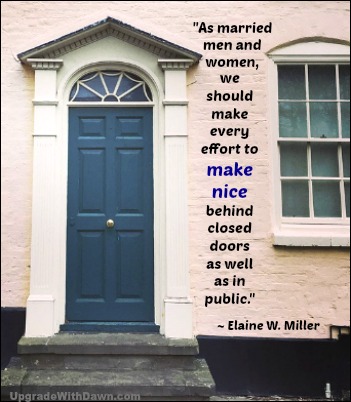
As married men and women, we should make every effort to make nice behind closed doors as well as in public. I know we can control our tempers. We do what we need to.

In the heat of anger, we politely answered the phone, “Good morning!” Yes, it is under our control. But for some reason I don’t understand (except that we are all sinners), we find it easier to make mean than to make nice to the ones we love. How foolish!

Making nice is something we need to do; it may not necessarily just happen. I like the synonym “do.” Just do it.

Do nice. Cause nice. Build nice. Create nice. Accomplish nice.

Making nice is a choice.

“Nice,” it turns out, comes from the Latin nescius, meaning “ignorant.” The computer dictionary defines “ignorant” as “unaware.” When our loved ones do something idiotic, be unaware of it. Ignore it. Overlook the mistake. Make nice.

One day I watched a husband make nice when he certainly could have made mean. He and his wife and my husband and I climbed an Adirondack mountain together. Inexperienced at climbing, the other wife wore sandals. What a mistake! This trip required sneakers at the very least – hiking boots at best.

As we trekked up the mountain, her discomfort became evident. Reaching the summit, her feet Rob with blisters, she agonized about her ability to descend the mountain.

What was your husband to do? He had a choice. He could yell from the top of the mountain, “I married an idiot! Why didn’t she wear better shoes?” He could have humiliated her with words like, “You are such a wimp! Stop your complaining.”

This husband didn’t choose those options. He chose to make nice. Without a word, he lovingly scooped up his love and carried her down the mountain.

This man realize the truth that on his wedding day he and his wife became one. When her feet hurt, it hurt him. Instead of making the pain grow deeper with thoughtless words, he decided to alleviate the pain.

I once wrote,

“Every day we decide the words and actions that will serve or suffocate our marriages.”

Every new day begins with choices. We choose what clothes to wear and what to eat for breakfast. We choose to sin. We choose to act like idiots. We choose to make nice or not.

Making nice is an investment that pays big dividends. Kind words and considerate deeds deposit love into our marriage love bank. Mean remarks and thoughtless actions count as love withdrawals. Take out too much, and there is no love left.

Making nice manifests itself in every aspect of your life, but especially in the bedroom. When you are unkind or unfaithful, it affects sexual intimacy. You can’t treat your spouse shabbily and then expect your beloved to jump into the sacred marriage bed.

Making nice makes a nice marriage. When meanness becomes the norm, marriages fail to thrive.

Here are three ways to make nice in your marriage:

1. Watch your words

Ephesians 4:29 says, “Do not let any unwholesome talk come out of your mouth, but only what is helpful for building others up according to their needs, that it may benefit those who listen.”

If in our desire to build ourselves up we put our spouse’s down, every derogatory remark registers in the brain creating a chill in the marriage vault. Negative words are like icicles stabbed into your loved one's heart that only kindness and forgiveness and making nice can melt.

When unkind words come from our condemning mouth, who benefits? No one. Certainly not the little ears that listen. Most are aghast when their children repeat words to the world that their parents say in private.

2. Don’t Demand Your Own Way

Love strives to live in peace (Hebrews 12:14), and God says love does not demand its own way (1 Corinthians 13:5). When we become angry and impatient and rude, most likely it is because we have not gotten our way. Philippians 2:3 says, “Do nothing out of selfish ambition or vain conceit, but in humility consider others better than yourselves.”

When we choose not to be self-seeking, we then become more patient and kind and not so easily angered. Then, as much as it depends on us, our homes will be peaceful.

3. Root out bitter roots

Hebrews 12:15 says, “See to it that… no bitter root grows up to cause trouble and defile many.” Our bad behavior does not come without consequences. It destroys our marriages.

The hurt of bitterness hurts not only the one the arrow is aimed at, but also others we love. That arrow penetrates our children’s hearts. Sometimes the wounds never heal, and the scars remain for a lifetime.

Marriage is not a competitive sport. The one who gives the most verbal punches does not win. You both lose because condemning your spouse is condemning yourself. God has declared you to be one flesh.

Verbal punches leave you both knocked out and too tired to fight for your marriage. Don’t let it happen. Make nice!

What did you say today that built up your spouse? What did you say that put down your partner? How can you make every effort to live at peace?

Elaine W. Miller is an international author and speaker known for sharing biblical insights with warmth, enthusiasm, and humor. She is the author of three books including her latest We All Married Idiots: Three Things You Will Never Change AboutYour Marriage and Ten Things You Can (available in English, Spanish, and Bosnian). Residing in upstate  New York with her husband of 45 years, she enjoys having three married children and 11 grandchildren close by. Visit Elaine's website/blog to learn more about her unique ministry.

This blog post was adapted from Chapter 9 in We All Married Idiots.

Graphic adapted, courtesy of christinevitved for Pixabay.

Tuesday
Sep062016

Kinda Kind

Kaley Faith Rhea is a bright young woman with a promising future, and her growth in wisdom shows! In this Spiritual Growth UPGRADE, she zeroes in on the need for intentional kindness.

"We tend, Kaley says, "to try to teach our children to be kind—to share and to say sweet words and to play nice, right? But between you and me, fellow grownups, we can be some real sass-mouth kids to each other!"

"Sass-mouth." I (Dawn) have never used that word, but oh, does it ever describe what I hear when some women talk. We need some conversational wisdom, for sure!

Kaley continues . . .

As a culture, we’re inclined to celebrate the zingers. The quick come-backs, the smart insults, the comic teasing.

Something in us loves to shout, “Ohhhh! Apply cool water to that burn!” after a particularly glorious gibe. And a lot of times, it really is all in fun.

We like to laugh. Big deal.

The potential problem is that for some it can be a bit habit forming. Has it become weird to look someone in the face and speak sincerely some kind words to them? Or to hear kind words spoken to you?

The truth is, we can so train our brains in this method of verbal sparring that we look to score points with hardly a conscious thought, while trying to honestly encourage someone is like trying to do calligraphy wrong-handed.

It’s uncomfortable. And it probably doesn’t turn out like what you had in mind.

But Ephesians 4:22 tells us to, “Be kind to one another, tenderhearted…” Those of you who have children, what could be sweeter to you than seeing your kiddos show kindness to each other?

Have you thought about ways you can bless your heavenly Father lately? Be kind. Be tenderhearted.

Where there may be discomfort or awkwardness or an odd feeling of vulnerability in the effort to replace glibness with kindness, think of Jesus and this opportunity you have to be sweet to Him.

I think sometimes today we get this idea that a kind person is this saccharine, obnoxious, weak, or false sort of person. So let’s be clear.

Kindness isn’t the same as lying or flattering or overlooking sin. In fact, sometimes confrontation is the kind thing to do.

Psalm 141:5 says, “Let a righteous man strike me—it is a kindness; let him rebuke me—it is oil for my head; let my head not refuse it.”

Replacing truth with feel-goodisms is no kind of kindness at all. It’s more like apathy, in fact.

But kindness does require approaching someone in love and with the understanding that you are not their superior. That their struggle could just as easily be yours. Kindness is dismissing the desire to put someone in their place and instead asking the Lord to use you however He wants in that moment, that you might see someone else victorious in Christ.

There is something a bit sinister, too, in the habitual teasing: it tends to keep things on a superficial level. It’s difficult to share personal struggles or victories or vices with someone whose tendency is to laugh things off or call things out.

So even if sharp but funny insults are the popular thing, they’re not generally what people are thirsting for.

We may celebrate the wit of the jokesters, but we are drawn to the hearts of the kind.

Probably because when people are being kind, they’re being like Jesus.

Galatians 5:22-23 says, “But the fruit of the Spirit is love, joy, peace, patience, kindness, goodness, faithfulness, gentleness, self-control; against such things there is no law.” Kindness is an evidence of the work of the Holy Spirit in you.

If you find yourself defaulting to clever put-downs or brush-offs, ask Him to change your mind. Ask Him to show you how to bless Him by blessing others with your words and actions.

Don’t make the mistake of believing that kindness is a lesson we ought to reserve for children. It’s massively important. It’s a command.

And it’s impossible to do it well without the help of our tirelessly kind and merciful Father.

How can you take kindness out of the Sunday School classroom and be intentional about it in real life?

Kaley Faith Rhea is the co-author of Turtles in the Road, releasing soon, with two more novels in the works. Along with writing and teaching at writers’ conferences, she co-hosts the TV show, That’s My Mom, for Christian Television Network’s KNLJ in mid-Missouri. Kaley lives in the St. Louis area.

Graphic: adapted, courtesy of Morguefile.

Thursday
Mar062014

When It's Best to Hold Your Tongue

I “met” Lina AbuJamra when I read one of her books, Thrive, a book primarily for singles. I was impressed with her grasp and practical application of biblical truth. I recently saw a post she wrote for a True Woman ministry and wanted to share it, with her permission, with UPGRADE readers so we can Upgrade the use of our tongue.

“I talk too much,” Lina wrote. “Way, way too much.”

Lina had me there … I just finished a discussion with my husband Bob about how I tend to talk too much in the car. Maybe it’s because poor Bob is a captive audience.

Lina continued …

But God is committed to teaching me when to hold my tongue. With that in mind, let me share ten situations where I'm learning it's better to refrain from talking:

1. When you have no idea what to say

Proverbs 17:28: "Even a fool who keeps silent is considered wise; when he closes his lips, he is deemed intelligent."

2. When you're wrongly accused

1 Peter 2:23: "When he was reviled, he did not revile in return."

Isaiah 53:7: "He was oppressed, and he was afflicted, yet he opened not his mouth."

3. When you're mad

Proverbs 25:28: "Like a city whose walls are broken through is a person who lacks self-control."

4. When you're confused about life

Lamentations 3:25–28: "The Lord is good for those who wait for him, to the soul who seeks him. It is good that one should wait quietly for the salvation of the Lord . . . Let him sit alone in silence when it is laid on him; let him put his mouth to the dust—there may yet be hope."

5. When you wouldn't want someone else to find out you said it

Luke 12:3: "Therefore whatever you have said in the dark shall be heard in the light, and what you have whispered in private rooms shall be proclaimed on the housetops."

6. When you don't really mean it

Proverbs 3:28: "Do not say to your neighbor 'Go, and come again, tomorrow I will give it,' when you have it with you."

7. When you can't stop yearning for the good old days

Ecclesiastes 7:10: "Say not, why were the former days better than these? For it is not from wisdom that you ask this."

8. When you have a lot to do and you don't like it

Philippians 2:14: "Do all things without grumbling or complaining."

9. When the timing is wrong

Proverbs 25:11: "A word fitly spoken is like apples of gold in setting of silver."

10. When you don't have anything to say that gives grace

Ephesians 4:29: "Let no corrupt talk come out of your mouths, but only such as is good for building up, as fits the occasion, that it may give grace to those who hear it."

Got any other tips on when to refrain from talking? Share them with our UPGRADE readers.

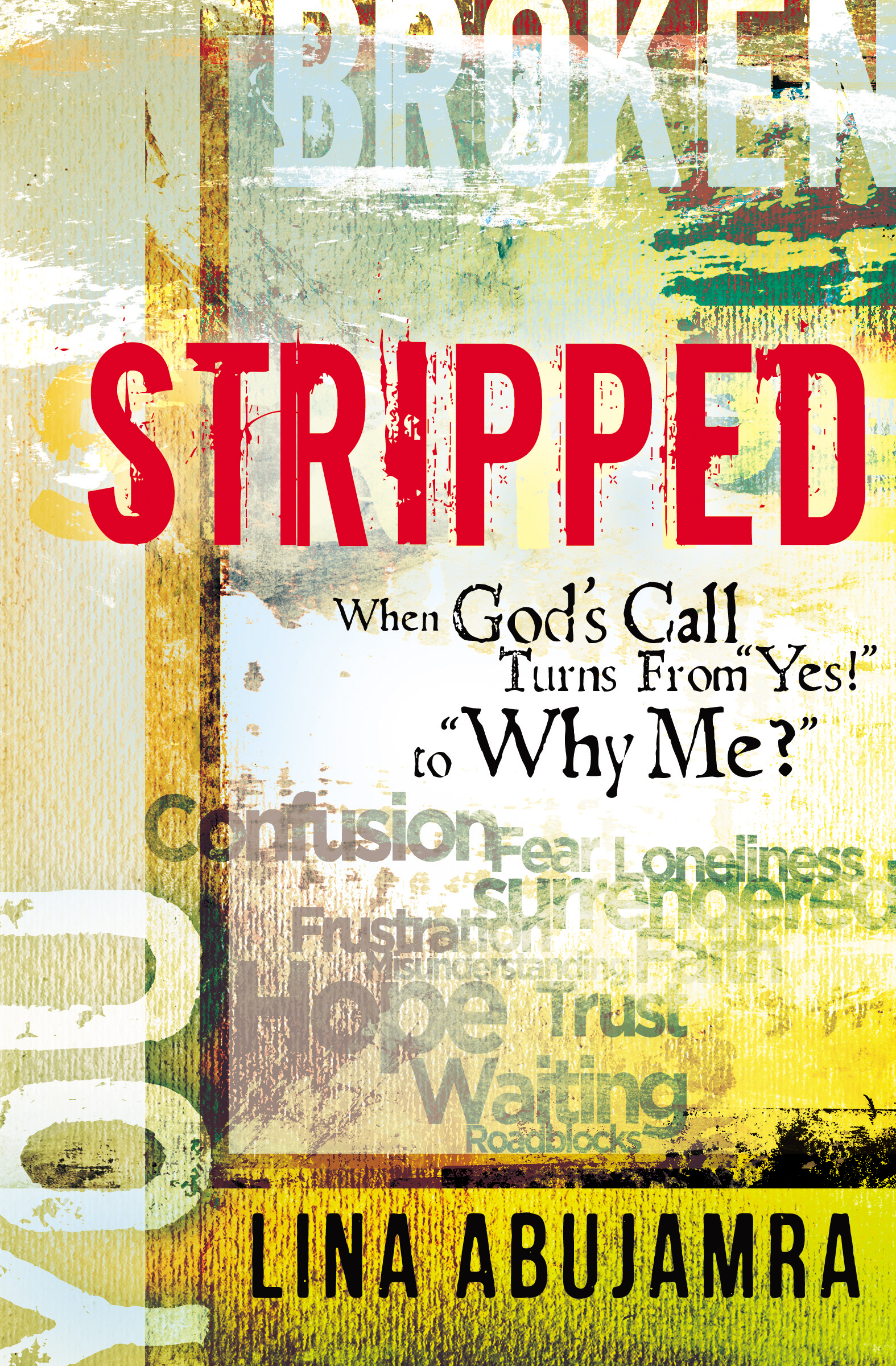
Lina AbuJamra is a Pediatric ER doctor, author, and speaker. Her passion is to apply her life-saving, decision-making, and hope-giving skills from the Emergency Room to rescue and recover people from spiritually deadly situations. Lina shares stories of faith at her popular blog. She has written two books:  Thrive: The Single Life as God Intended,  and Stripped: When God’s Call Turns from Yes to Why Me? Lina lives alone in Chicago, although she does have many friends. You can connect with her daily at livingwithpower.org.


Wednesday
May082013

Six Secrets to 'Superb Communication'

Whether we are preparing to share a testimony, give a devotional, or create a message or lecture, there are some basic things we can do that will help us UPGRADE our communication. 

Meet Maria Keckler, founder and director of Superb Communication, who offers some wise advice. These tips can also help with our social media communication, and we may even be able to apply most (if not all) of these “secrets” to our communication in personal relationships! Superb communication makes a difference anywhere!

SUPERB COMMUNICATION INFOGRAPHIC

Did you get those steps? Superb communication tells a story, and is useful, prepared, eloquent, reliable and brief—to the point.

Which communication secret do you think would most UPGRADE your communication to others?

Maria Keckler is a speaker, author, and the president of Superb Communication, a consulting firm that specializes in improving results and reducing the cost of change through more robust communication. Read about and download Maria's latest tool that helps improve productivity by 30%.