




Member of AWSA

  Info about AWSA


[Bios on Partners Page]

PARTNERS:

Lina AbuJamra

Sue Badeau

Dianne Barker

Twila Belk

Gail Bones

Harriet Bouchillon

Mary Carver

Pamela Christian

Lisa Copen

Erin Davis

Diane Dean

Deb DeArmond

Kelly DeChant

Danna Demetre

Melissa Edgington

Debbi Eggleston

Pat Ennis

Morgan Farr

Pam Farrel

Liz Cowen Furman

Gail Goolsby

Sheila Gregoire

Doreen Hanna

Holly Hanson

Becky Harling

Debbie Harris

Nali Hilderman

Cathy Horning

Kathy Howard

Mary James

Priscilla Jenson

Lane P. Jordan

Rebecca Jordan

Ellie Kay

Maria Keckler

Sylvia Lange

Debby Lennick

Peggy Leslie

Kathi Lipp

Kolleen Lucariello

Kathi Macias

Paula Marsteller

Melissa Mashburn

Dianne Matthews

Cindi McMenamin

Elaine W. Miller

Kathy Collard Miller

Lynn Mosher

Karen O'Connor

Yvonne Ortega

Arlene Pellicane

Ava Pennington

Laura Petherbridge

Gail Purath

Marcia Ramsland

Kaley Rhea

Rhonda Rhea

Vonda Rhodes

Cynthia Ruchti

Julie Sanders

Judy Scharfenberg

Deedra Scherm

Laurel Shaler

Joanie Shawhan

Stephanie Shott

Poppy Smith

Susan K. Stewart

Stacie Stoelting

Jill Swanson

Janet Thompson

Janice Thompson

Teri Thompson

Brittany Van Ryn

Elizabeth Van Tassel

Leslie Vernick

Laurie Wallin

Julie Watson

Joan C. Webb

Cherri Williamson

Kathy C. Willis

Debbie W. Wilson

Nancy DeMoss Wolgemuth

Jamie Wood

   and Founder:

   Dawn Wilson


Entries in Leadership (9)

Tuesday
Aug092016

God Harvests Fruit From Mentoring Seeds

With wise words and sweet songs, Dr. Gail Bones invites women to a place of change in Christ and the cross. In this unique UPLIFT/Mentoring UPGRADE, she shares a personal note from someone changed by her ministry.

A decade ago, God allowed me to mentor a younger woman in ministry," Gail says. "Years later, she wrote to thank me for equipping her to invest in the next generation."

We don't often get an opportunity to see how God uses our ministry. I (Dawn) am so glad Gail received this tremendous blessing. It encouraged me to think how God might be using us in ways we don't yet understand.

Gail has truly been a Titus 2 woman, equipping and encouraging younger women.

Gail continues . . .

I’m grateful that the seeds I’ve planted in her life continue to produce a rich harvest.

Her words can serve as an encouragement to all who hear the call to mentor but may feel uncertain as to how to go about it.

You’ll see it took no special talent or herculean effort. We just planned to spend regular time together walking and talking. 

Be inspired by some of her cherished words to me about our mentoring relationship:

Thank you for loving me so well. You cared about the things I cared about. You let me lead out in conversation about things that were on my heart and mind without making me feel silly or juvenile for giving my attention to things that, looking back, seem so shallow.

You affirmed and pointed out my strengths. You let me plan a party for my young adult group at your house and afterwards said, "You are really good at putting on events and bringing people together.” You gave me the confidence to continue to have people over often, even now. 

You told me I had the gift of exhortation and, because of your affirmation, I ask God to use my voice in that way as I minister to the people He entrusts to my care.

One of my deepest cares was whether I’d ever get married. You always told me I was beautiful inside and out, and helped me to believe that God did in fact have someone very special for me who would see me that way too.

You shared your life with me, and were vulnerable, letting me into the good, the bad and the ugly of your life. My admiration for you grew deeper as my understanding of the Lord and his grace through your story changed me. This became part of the spiritual foundation I stand on today, and the hope I cling to in times where I feel like I’ve lost my way. Through your story, I learned that God is gracious, and not only is He gracious, He is good. When we search for him we find he is loving, compassionate, and forgiving.

You were also honest about marriage and family, finances and your self-doubt. That honesty prepared me for my own marriage and life as an “adult.” You gave me the confidence to take life head-on and to not be so afraid.

When I cried, you cried, and you taught me that emotions were okay. Watching you cry made me feel like women can be strong and they can be emotional; the two can co-exist.

You inspired me to read, something that I still love to do today. This has opened my world to new information and wisdom that I use every day in ministry.

Thank you Gail, I love you! 

What impact could you have in the life of another as a mentor if you’d be willing to trust God’s Holy Spirit to guide you? Who is he placing in your path?

Ask the Lord to show you who He has in mind for you to mentor and be mentored by.

Dr. Gail Bones is a speaker, retreat leader, songwriter/worship leader, former professor of education and the founder of CrossWise Living, an intergenerational ministry devoted to helping people navigate change. She and her husband Jeff have two married children. From the east coast but now living in San Diego, Gail says “happiness” means always having one or more of the following in her hands: a dog leash, a sailboat rudder, bicycle handlebars, a kayak paddle, an acoustic guitar, a big fat book or a hazelnut coffee. Be blessed by her Bible studies or her newest CD, "Still," and read more about Gail at her website/blog.

NOTE: The full story of how God brought us together and began my cross-generational ministry can be found in Living CrossWise: Hope and Help for Navigating Transition.

Graphic of strawberries adapted, courtesy of Morguefile.

Thursday
Jun162016

Taking Care of Yourself as a Leader

Nali Hilderman teaches women in a biblical framework, and in this Leadership UPGRADE she encourages women in leadership to take time to rest and refuel.

“While leadership can be incredibly life-giving and exciting," Nali says, "there are times when it is draining and exhausting too.”

Oh Nali. That is so true. Leadership can be a blessing and a burden at the same time. The Lord calls us to be wise in balancing our schedules—to build our lives, not just the lives of others.

Nali continues . . . 

As a leader, are you weary? If you’re anything like most other leaders, I would venture to say that your answer is yes! 

While leadership can be incredibly life-giving and exciting, there are times when it is draining and exhausting too. It’s the excitement of influencing others and utilizing your gifts that make leadership worth it in the long run, but what do you do when you find yourself in those seasons of weariness?

And how can we work at preventing those seasons? 

It may seem selfish or counter-productive to do this, but Christ, the perfect leader, provided an example of this during His ministry when He left the crowds to spent time with the Father or just the disciples (Luke 4:42, 5:16; John 13). And He encourages us plainly to come to Him when we are tired and weary so He can help us (Matthew 11:28-29)!

Therefore, I want to suggest three ways to take care of yourself as a leader so you can continue to be effective in loving and serving others.

1. Participate in Life-Giving Activities

Most of us have activities that bring us deep joy and provide “soul time” that are not related to our work as leaders. It may be exercise, art, reading, spending time in nature, napping, cooking, taking a bubble bath – or any number of things!

Sometimes our schedules are so busy that we feel like we don’t have time to do anything but what’s already on the calendar, but if we are to continually pour into others throughout our day, we must find time to participate in activities that provide respite for our soul.

I challenge you to discover these areas and set aside time in your calendar to participate in them!

2. Find Others That Pour Into You

As a leader, you are probably constantly pouring into others around you. This is usually very life-giving and one of the main reasons we get involved in leadership in the first place, but, do you have someone pouring into you? Do you have a mentor? Do you have friends, or a small group of people that you do not “lead” that refresh and revitalize you and care for your soul? 

This is absolutely vital as a leader to have others lead and guide you so that you are refueled to lead and guide others. 

Scripture is full of examples of the life-giving nature of the body of Christ. See, for example, the relationship between the Apostle Paul and Timothy as Paul instructs, encourages and mentors the young minister in Ephesus (1 Timothy 1; 2 Timothy 1). I encourage you, likewise, to seek out and spend time with these vital care givers in your life on a regular basis.

3. Find Sustenance from the Lord

For many of us who are leaders in Christian ministry, there’s a tendency to always “do ministry”—even in our personal time with the Lord.

As a leader, it is vital that you protect your time with the Lord as just that – YOUR time with the Lord.

Make sure that you are abiding in Christ for yourself, not your ministry, for apart from Him we can do nothing (John 15:5). 

And the Word says that if we seek Him and His Kingdom first (Matthew 6:33), then all other things shall be added to us. How is your time alone with Christ? 

How’s your weariness level? How are you doing in taking care of yourself regarding to these three areas? Making sure you take care of yourself is vital to continuing to love and care for others as Christ has commissioned you!

Nali Hilderman is a professor of American history at San Diego Christian College and Director of the college’s Dr. Henry Morris Leadership Program. She studies women’s history and Christian theology, trying to make sense of how to be a confident, successful Christian woman who does not buy into the secular feminist mentality. She attends Journey Community Church in La Mesa, CA.

Graphic of woman in nature, courtesy of Morguefile.

Tuesday
Feb022016

Rethinking Single Leadership

A strong woman of purpose, Nali Hilderman encourages women—both by her teaching and in her life example—to embrace Christian leadership at all ages and stages of life. She knows this is difficult for some single women.

“If you’re feeling unimportant in your singleness,” Nali said, “I’d like to challenge you with a biblical perspective.”

When I (Dawn) was a young single woman, a Christian ministry offered me strong reasons to see my singleness as a gift from God. I'm so glad Nali is addressing that in this Leadership UPGRADE.

Nali continues . . .

While there are many examples in the Bible of women that God used—some married, some single—we should focus on obedience to Him in whatever stage of life we find ourselves.

Nowhere does the Bible indicate that your ability to make a difference for Christ and His Kingdom is dependent on your marital status. 

However, I know sometimes it can feel like you’re overlooked and unimportant in the Church if you don’t have a husband and family. 

Here are three reasons you really do matter in the Kingdom of God.

1. Rethink Leadership.

We often tend to think that leadership is about position, personality or platform, which includes certain “requirements” you may feel you don’t have as a single woman. 

The reality is, leadership is mainly about the ability to influence others, serve them and—in Christian leadership—point them towards Christ. 

These things you can do successfully, regardless of whether you’re married or not. 

“Leadership is being alive with truth and love in your sphere of influence.”

That is something anyone can do!

Focus on those God has placed in your path, and work on serving and loving them. This is the most powerful form of influence.

2. Examine and Use your Spiritual Gifts.

Just as there is nothing in Scripture that indicates the gifts of the Holy Spirit are either “male/female,” so there is no designation that some gifts are given to married people and some are for singles.

Because of this, take time to find out what your gifts are and set about using them for the edification of the Church (1 Corinthians 12:7).

You can take free online tests to find out which gifts are your strengths.*

Also, spend time studying 1 Corinthians 12 to learn what the gifts are, what their purpose is, and how each gift is important in the body of Christ.

3. Steward Your Time.

I know this sounds cliché, but as singles we often have more time on our hands than our married friends. Paul is speaking truth when he says married people are concerned with the affairs of their spouse and needs of their children, while single people are “concerned about the Lord’s affairs” (1 Corinthians 7:32-35). 

I know it’s easy to spend time focusing on what we don’t have, but ask yourself, “Am I being a wise steward of the time I have now? Am I serving the Lord—using my gifts to edify the Body of Christ?”

You have the ability to make a significant impact on others during your singleness.

These are three important ideas regardless of what season you find yourself in, but they are especially challenging if you are single and feeling like you cannot have an impact for Christ.

You do matter in the Kingdom of God!

If you are single, which of these three points is hardest for you? What can you do to increase your effectiveness for the Kingdom of God?

Nali Hilderman is a professor of American history at San Diego Christian College, and Director of the college’s Dr. Henry Morris Leadership Program. She studies women’s history and Christian theology. Always seeking how to become a confident, successful Christian woman, she does not buy into the secular feminist mentality. Nali attends Journey Community Church in La Mesa, CA.

* Two free Spiritual Gifts tests are here and here.

Graphic adapted, image courtesy of pixabay.

Tuesday
Apr282015

How to Earn the Right to Share Your Story

Maria Keckler is a natural coach. She offers keen counsel to help build bridges in ministry, leadership and personal relationships—an UPGRADE of great importance!

“Empathy,” Maria says, “is the ability to stand in our audience’s shoes, see through their eyes, think through their perspective, and feel with their hearts.”

Have you ever seen an empathetic person in action? I (Dawn) have. She was selfless and genuinely concerned, fully engaged—heart and mind. She listened until she understood! “What a gift,” I thought.

Maria continues ...

Jesus is empathy personified. God wrapped himself in flesh and walked the earth as a man and can forever say,

I know what it’s like to be you. I know how it feels to be tempted, to lose someone you love, to endure rejection and physical pain.”

And isn’t that why you listen to Jesus—to His story? You know He cares about you because He knows what it’s like to be you.

Empathetic Listening Unlocks the Heart

I’ll never forget a time my husband was facilitating a group listening activity in which participants were asked to pair up. The “listener” was instructed to ask personal questions in order to better understand what his or her communication partner cared deeply about. The “listener” had to be attentive and couldn’t interrupt until the person sharing was completely finished.

Half way through the activity, a woman excused herself and walked out of the room. Later, she shared privately that it was out of character for her to be so emotional—especially in public—but it was the first time in her adult life she felt truly heard.

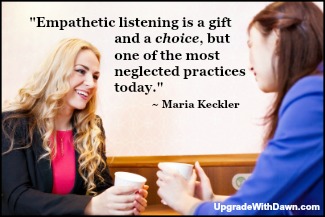
Empathetic listening is a gift and a choice, but one of the most neglected practices today.

When we are:

  • Listening in order to have a chance to respond ...
  • Listening to quickly insert our own story ... 
  • Listening to find a “sin” we can address with a Bible story ...
  • Listening with contempt ... 

... these forms of listening are NOT empathetic listening and will get in the way when we finally get the chance to share our story.

Earning an Invitation to Share

My friend Diane Szuch earns the right to share her story with women whose joy has been stolen and heart has been broken at the feet of sexual abuse, because she first listens to them with extraordinary empathy—and so can you.

What does empathetic listening look like?

The traditional Chinese symbol for listening gives us the clues to empathetic listening. It contains the characters for ears, eyes, attention (mind), heart, and king. In other words, we are to listen fully engaged as in the presence of the king.

In practical terms…

  1. Be fully present. Put away the phone.
  2. Listen with your eyes. Make eye contact, but don’t be creepy about it. Natural eye contact is not a staring contest.
  3. Listen with your body. Lean in, nod and affirm.
  4. Listen with your heart. Withhold judgment.
  5. Convey empathy. Offer neutral but authentic acknowledgement remarks to indicate you are present. (Really! Wow! Mmm ... Oh my!)
  6. Embrace silence. Silence can be one of the most powerful elements of a conversation, opening doors to vulnerability and intimacy.

There are many times we are ready and eager to share our story, but the right opportunity never seems to come.  But you can turn things around today!

How can listening more—and more empathically—help you build a bridge to the hearts of those God has put in your path? 

Maria Keckler has been coaching married couples (with her husband) for more than 15 years. They’re teaching leaders at Shadow Mountain Community Church. Maria is an executive coach, corporate trainer, and the author of Bridge-Builders: How Superb Communicators Get What They Want in Business and in Life. She invites readers to follow her blog and purchase her book.

Graphic adapted, Image courtesy of Serge Bertasius Photography at FreeDigitalPhotos.net.

Thursday
Mar192015

Leadership: A Tale of Two Cities

Nali Hilderman’s love of women’s history and Christian theology gives her an impassioned desire to help women make a difference in today’s culture. In this Leadership UPGRADE, she challenges our thinking.

“While there are many different theories regarding leadership,” Nali says, “there are some key differences between how the world defines it and how the Bible defines it.”

I (Dawn) love to read leadership blogs—both Christian and secular, and I know she is right. A biblical perspective on leadership not only changes our motives; it also changes our methodology.

Nali continues . . .

In the fifth century, Saint Augustine wrote a now famous treatise titled “The City of God.” Augustine explained some key differences between the rule and attitude of the “city of man”— ruling empires of the world—and the “city of God” (which is made up of the followers of Christ and His church). 

This idea of comparison can be applied to theories related to leadership in today’s modern world. While there are many different theories regarding leadership, there are some key differences between how the world defines it and how the Bible defines it.

Colossians 2:8 commands us not to be taken captive by philosophies of this world, but rather to focus on Christ.

As Christ’s followers it is wise for us to understand these distinctions and seek to live out the principles of the City of God in our leadership.

Distinction #1

The City of Man considers power over others as a key component of leadership. Society tends to laud those who are wealthy, powerful and successful as leaders.

However, the City of God considers serving others as the key component of leadership. Christ admonished His disciples when they asked who will be the greatest among them. He told them they are not to rule as the Gentiles do. He says that the last shall be first in the Kingdom of Heaven and that He Himself did not come to be served, but to serve (Matthew 20:24-28). 

Ask yourself, “How am I using my leadership in regard to others? Am I lauding my power over others, or am I serving others for their betterment?

Distinction #2

The City of Man considers influence as a key descriptor of leadership. Society tends to value the number of blog posts, YouTube views, Twitter followers, and albums sold as indicators for who is “leading.” Often, leaders in the City of Man wield their influence for selfish and worldly gain. 

While the City of God also values influence as a key component of leadership, the purposes driving influence are wholly different.

We are not to lead for selfish gain, but are commanded in scripture to not think more highly of ourselves than we ought.

Also we are to pursue compassion, love, righteousness, and truth (Philippians 2:3-5, Colossians 3:12-15).

In his book, Creation Regained: A Reformational Worldview, author Albert Wolters challenges:

"Anything in creation can be directed either toward or away from God—that is, directed either in obedience or disobedience to His law. *

As you lead today, take time to reflect on whether your leadership is turning people towards fulfilling their own selfish ambition or towards a spirit of love and truth.

How you are wielding power and influence in the lives of others? Have you been “taken captive” by the world’s philosophy of leadership, or are you a woman pursuing the City of God and leading others in a biblical way?

Nali Hilderman is a professor of American history at San Diego Christian College and Director the college’s Dr. Henry Morris Leadership Program. She studies women’s history and Christian theology, trying to make sense of how to be a confident, successful Christian woman who does not buy into the secular feminist mentality. She attends Journey Community Church in La Mesa, California.

* Albert M. Wolters, Creation Regained: Biblical Basics for a Reformational Worldview, (Wm. B. Eerdmans Publishing Co, 2005), p. 49.