


Search
Follow UPGRADE

   Member of AWSA

  Info about AWSA


[See their Bios on the Partners Page by clicking on the Blogger box, above]

     PARTNERS:

Lina AbuJamra

Sue Badeau

Dianne Barker

Twila Belk

Dr. Michelle Bengtson

Gail Bones

Harriet Bouchillon

Mary Carver

Jeanne Cesena

Pamela Christian

Lisa Copen

Erin Davis

Diane Dean

Deb DeArmond

Kelly DeChant

Danna Demetre

Melissa Edgington

Debbi Eggleston

Pat Ennis

Morgan Farr

Pam Farrel

Sally Ferguson

Liz Cowen Furman

Gail Goolsby

Sheila Gregoire

Kate Hagen

Doreen Hanna

Holly Hanson

Becky Harling

Debbie Harris

Nali Hilderman

Cathy Horning

Kathy Howard

Mary James

Priscilla Jenson

Lane P. Jordan

Rebecca Jordan

Ellie Kay

Maria Keckler

Sylvia Lange

Debby Lennick

Peggy Leslie

Kathi Lipp

Kolleen Lucariello

Kathi Macias

Paula Marsteller

Melissa Mashburn

Dianne Matthews

Cindi McMenamin

Elaine W. Miller

Kathy Collard Miller

Lynn Mosher

Karen O'Connor

Yvonne Ortega

Arlene Pellicane

Ava Pennington

Laura Petherbridge

Gail Purath

Marcia Ramsland

Kaley Rhea

Rhonda Rhea

Vonda Rhodes

Cynthia Ruchti

Julie Sanders

Judy Scharfenberg

Deedra Scherm

Laurel Shaler

Joanie Shawhan

Stephanie Shott

Poppy Smith

Susan K. Stewart

Stacie Stoelting

Letitia "Tish" Suk

Jill Swanson

Janet Thompson

Janice Thompson

Teri Thompson

Brittany Van Ryn

Elizabeth Van Tassel

Leslie Vernick

Laurie Wallin

Julie Watson

Joan C. Webb

Shonda Savage Whitworth

Cherri Williamson

Kathy C. Willis

Debbie W. Wilson

Nancy DeMoss Wolgemuth

Jamie Wood

And UPGRADE'S Founder

   Dawn Wilson


Entries in Personal Care (3)

Thursday
Nov152018

3 Steps to Joy for Young Mothers

Kate Hagen's desire to help mothers is an outgrowth of her counseling ministry; but more than that, she loves young moms and feels compassion for their struggles. In this Personal Care UPGRADE, she suggests three ways young mothers can include more joy in their lives.

Kate says, "I wish I could go back and tell myself these three things." 

Oh, Kate got me (Dawn) there! So many things I'd tell my younger self, now that I'm seeing life from a more seasoned point of view!

Kate continues . . . 

Yesterday I was reading a journal from my early years of motherhood. As I read my old entries, I was heavy hearted as I remembered all the guilt and desperation I felt—always wishing I was doing better.  

I want to go back to that Kate and give her a hug.

I want to tell her:

  1. Enjoy your kids more!
  2. Release guilt about not feeling connected to God.
  3. You're doing the best you can right now! And it's enough.

If Kate from 10 years ago could spare 15 minutes, I would expound by telling her about these three steps to joy. 

But I would make it quick, because there would be a child to run after at any minute!

1. Enjoy your kids!

How? 

Look for God's image in them. When you see them in the morning, and you're a Zombie monster due to a terrible night's sleep, look into their big eyes and think, "You are made in the image of God."

I promise, it will help! God’s loving image is there, even when they won't let you go to the bathroom by yourself.

One of the best mom verses is I Peter 4:8, "Above all, love each other deeply, because love covers a multitude of sins."

Yes, my kid's sins (shortcomings) are covered as I love them, and SEE God's love in them.

Be your kid’s biggest cheerleader.

I remember deciding I wanted to be seen by my kids as a cheerleader more than a police. It was a life-changing decision that positively affected my relationship with my kids immensely.

As much as possible, be slow to anger and slow to speak, and instead be quick to listen and quick to forgive.

 These contrasting ideas will really help you enjoy your kids more. It’s a guarantee.

Have these be your rules: less talk; more listening. Don't worry if you break them. You will. But, have them be your standard. (God does.)

2. Release guilt about not feeling connected to God.  

I spent so much time and ink feeling bad about not being close to God.

It's good to cry out to God. It's very Psalmist!

But I think I often missed the joy God was trying to give me by longing for it to come the way it used to. Before kids. 

I wanted the old, deep, spiritual connection I had when I was 20 and had all the time in the world to spend in meditation. This was NOT possible during this season. 

Letting this expectation go, and enjoying the ways God WAS showing up, might have brought me a lot more joy. Looking for things to be grateful for, writing them down and speaking them aloud could have changed my joy-level greatly!  

Some of the ways God was showing up for me when my three kids were constantly needing me—and I had no time to meditate: 

  • In my baby's laughter
  • In chunky thighs (If God's not there, I don't know where God is!)
  • In sweaty hands grabbing for mine
  • In baby arms gripping the back of my neck

3. You’re doing the best you can right now. And it’s enough. 

"I'm not being the best mom/wife/friend I want to be."

That's true! Let that be true. And let that be okay.

It's really just an ego-centered thought. It's focused on you, not the other person. Feeling guilty that you're not enough isn't helping anyone! It's not a Jesus thought.

Let it come—it's ok that it's there—and then let it go.  

You're not being the best mom in the world. True! But, treat yourself the way God does. Be gracious with yourself. Forgive yourself for not being perfect.  

I'd like to go back to that old Kate, give her a hug and tell her what a good job she's doing. Remind her to constantly be looking for ways to enjoy her kids. Encourage her to treat herself the way God treats her... full of compassion, mercy and love.  

What would you go back and tell yourself?

Kate Hagen spends most of her time teaching, knowing and loving her three kids in their beach community of Leucadia, CA. She has a Master’s Degree in Biblical Counseling and has written, spoken and counseled women about mothering, body image and health. She runs a small essential oil business from her home, and usually smells pretty good. At her website you can read her journey of grieving and laughing as her mom passed of cancer, as well as her thoughts on the Bible and body image. 
Graphic adapted, courtesy of svklimkin at Morguefile.

Thursday
Oct182018

12 Traits of Unsafe People

Counselor and Bible teacher Debbie W. Wilson helps people develop relevant faith. She also teaches people practical wisdom from scripture. In this Relationship UPGRADE, Debbie clearly defines a group of people that might harm us.

She asks, "Do you have an unsafe person in your life?"

I (Dawn) do have some people that seem to flash warning signs when I'm with them. Most people have some "unsafe" people in their lives, and sometimes it's hard to know how to respond to them. I'm glad Debbie is tackling this issue.

Debbie continues . . .

Jacob’s father-in-law and employer for twenty years was an unsafe person. Laban’s name means white. But he was a dark cloud for Jacob.

Unsafe people live, work, and worship among us.

They may appear friendly and good. But beneath their scrubbed exterior lies a dark streak.

Laban betrayed his daughter Rachel and Jacob by switching the bride the night of the wedding. He cheated Jacob by changing his wages ten times.

His story helps us identify the unsafe people in our lives.

               12 Traits of Unsafe People

1. Unsafe people use you as long as it benefits them.

Laban wanted Jacob to stay while Jacob made him prosperous (Genesis 30:25-28).

2. Unsafe people are reasonable to your face but undermine you behind your back. 

Laban agreed to give Jacob the spotted and streaked animals as his wages, but he gave them to his sons instead. He thought leaving the solid colored herds would decrease Jacob’s chances to raise spotted animals (Genesis 30:34-36).

3. Unsafe people are threatened by your success and disregard your faithfulness.

Jacob’s growing herds threatened Laban’s sons. Laban’s attitude changed toward Jacob. They forgot Jacob’s work had made them rich (Genesis 31:1-3).

4. Unsafe people can’t thwart God’s blessings or will for you.

Every time Laban changed Jacob’s wages, God intervened.

If Laban said, “The speckled ones will be your wages,” then all the flocks gave birth to speckled young (Genesis 31:4-9).

5. Unsafe people don't determine your well-being.

Rachel and Leah acknowledged the bounty their heavenly Father had provided in spite of their father wronging them (Genesis 31:14-16).

6. Unsafe people are on God’s leash.

Jacob was no match for Laban’s men. He didn’t have to be.

God appeared in a dream and stopped Laban from attacking Jacob (Genesis 31:24).

7. Unsafe people manipulate with guilt and shame.

They make you the villain and themselves the victim.

Jacob had the cooperation of his wives (Genesis 31:4-16), but Laban accused him of carrying them off like captives in war.

“You didn’t even let me kiss my grandchildren and daughters goodbye. You have done a foolish thing.” (See Genesis 31:26-28.)

8. Unsafe people's true intentions come out through their unguarded words.

“I have the power to harm you; but God stopped me” (Genesis 31:29).

What? I thought you said Jacob had no cause to run off in secret.

9. Unsafe people are mercenary.

Decisions are based on personal profit—not kindness, relationship, or right and wrong (Genesis 31:38-41).

10. Unsafe people believe they are entitled—me, my, mine! 

Jacob worked twenty years for his wives and flocks.

Laban said, “They’re mine!” (Genesis 31:43).

11. Unsafe people hypocritically accuse you of their ill motives.

Laban said, “If you mistreat my daughters….”

Laban had already wronged Rachel and Leah (Genesis 31:15, 50).

12. Unsafe people are distrustful because they assume you share their ill will.

Laban wanted a watchtower to keep Jacob from harming him and promised he wouldn't pursue Jacob.

Yet, Laban's the one who chased Jacob to harm him and had repeatedly cheated him (Genesis  31:51-52).

Laban debunks the myth we should trust people just because they are family members, authority figures, or claim to be believers.

Don't feel guilty if your caution light flashes when you are around someone.

Ask God for discernment and then boldly heed it.

Eventually, Jacob and his family had to separate from Laban and his sons.

The Bible says:

If it is possible, as far as it depends on you, live at peace with everyone” (Romans 12:18 NIV).

Sadly, sometimes it is not possible to live at peace with some people and be true to our walk with God.

What traits concerning the people with whom you live and work alert you to proceed with caution?

Debbie W. Wilson—drawing from her personal walk with Christ, twenty-four years as a Christian counselor, and decades as a Bible teacher—speaks, writes, and coaches to help others discover relevant faith. She is the author of Little Women, Big God: It's Not the Size of Your Problems, but the Size of Your God and Give Yourself a Break: Discover the Secrets to God's Rest. Find her at her blog, Refreshing Faith.

Graphic adapted, courtesy of MGDboston at Morguefile.

Thursday
Sep132018

Rebuilding Our Lives After a Winter Season

Joanie Shawhan is a wise encourager. She uses the experiences of her life, couples them with God's truth, and speaks that truth into others' lives. In this Personal Care UPGRADE, she explains some of the ways we can rebuild our lives after a tough season.

"Sometimes my life," Joanie says, "seems to mirror the two seasons dominating Wisconsin—winter and road construction."

HA! I (Dawn) lived through many winters in the Midwest, and I know exactly what Joanie's talking about. But there's a deeper application here.

Joanie continues . . .

For me, a diagnosis of ovarian cancer raised a stop sign and detoured me into a winter season.

Major life events can divert us into the barrenness of winter: loss of a loved one or a job, changes in finances or health, disruption of our marriage or home. Customary rites of passage such as moving, career changes, graduations, empty nest and retirement may also reroute us into a winter season.

But eventually winter yields to spring.

We attempt to merge into the previous traffic patterns of life, but discover that the flow has shifted.

Questions pop up like orange construction barrels.

  • Who am I in light of these life changes?
  • How do I re-engage?
  • What is my purpose?

My Story

When I emerged from my winter season of cancer, surgery and chemotherapy, I reached a crossroads filled with questions.

  • Who am I as an ovarian cancer survivor?
  • What do I do now?
  • How do I rebuild my life?

I sought out other ovarian cancer survivors, but found no support groups, Gilda’s Clubs or Facebook groups. Were there other survivors?

As I searched for answers, I joined a Christian writing group, Friends of the Pen. I started writing a book for women undergoing chemotherapy—the stories of everyday women with everyday lives interrupted by cancer, concluding each piece with a scripture and a prayer.

My hope was to provide the help I desired throughout my own ordeal.

I finally met other ovarian cancer survivors at an ovarian cancer camp in Missoula, Montana—Camp Mak-A-Dream. Some of these survivors were involved in a program called Survivors Teaching Students (STS) in which they shared their stories with medical students and other health care providers. These presentations raise awareness for ovarian cancer in hopes of earlier detection, thus saving women’s lives.

As a nurse and an ovarian cancer survivor, I was excited about joining the STS volunteer team.

While participating in STS, I met local ovarian cancer survivors. We formed an ovarian cancer group, “The Fried Eggs—Sunny-Side Up.” We meet monthly, sponsor speakers, plan fun outings and participate in fundraisers for ovarian cancer.

A cancer detour steered me into a new purpose and calling for my life—to write a book encouraging women undergoing chemotherapy, and to advocate for women and educate regarding ovarian cancer.

Several new roads were paved into my life. I love the changes.

If you find yourself in a construction zone following your own winter season, don’t lose heart.

Instead, consider these 7 areas of focus as you reconstruct.

7 Tips to Rebuild Your Life

1. Pray.

Ask God what He has for you in this new season of life. Study His word. Ask Him for specific scriptures that define this season.

2. Identify Your Passion.

What energizes or inspires you? Cancer awareness, pregnancy information, adoption, foster care, civic or church activities?

3. Dream Dreams.

Are there dreams you have laid aside or new dreams you discovered? Travel, write a book, learn a language, play an instrument, own a home, start a business?

4. Try a Hobby.

What activities do you enjoy? Music, photography, crafts, painting, gardening, traveling, biking, hiking, reading?

5. Use Your Talents.

What are those things that come easy for you?

Have others around you affirmed a particular gift or ability?

6. Try Something New.

Try a job, class, mission trip or volunteer opportunity.

When we attempt a new activity, we may discover a hidden talent or the ability to do something we never thought possible.

7. Connect.

We often relate with people who have undergone a similar experience.

In sharing our stories, we can make new friends as we help and support one another.

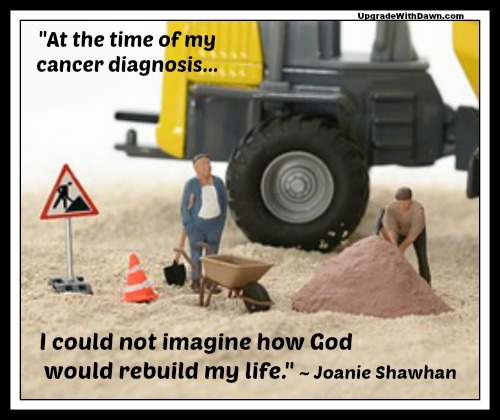
At the time of my cancer diagnosis, I could not imagine how God would rebuild my life. What began as a winter journey blossomed into a life enriched by the wonderful people I met along the way, including my Christian writing community and my fellow ovarian cancer survivors.

“No eye has seen, no ear has heard, and no mind has imagined what God has prepared for those who love him” (1 Corinthians 2:9 NLT).

How has God rebuilt your life after a winter season?

Joanie Shawhan is an ovarian cancer survivor and a registered nurse. She writes articles and encouragement for women undergoing chemotherapy. Publishing credits include Coping with Cancer Magazine, Upper Room and God Still Meets Needs. Visit with Joanie here.

Graphic adapted, courtesy of Annca at Pixabay.