




A member of AWSA

  Member of AWSA

  Info about AWSA


[Bios on Partners Page]

Lina AbuJamra

Sue Badeau

Dianne Barker

Twila Belk

Gail Bones

Harriet Bouchillon

Mary Carver

Pamela Christian

Lisa Copen

Erin Davis

Diane Dean

Deb DeArmond

Kelly DeChant

Danna Demetre

Nancy Leigh DeMoss

Melissa Edgington

Debbi Eggleston

Pat Ennis

Morgan Farr

Pam Farrel

Renee Fisher

Liz Cowen Furman

Sheila Gregoire

Doreen Hanna

Holly Hanson

Becky Harling

Debbie Harris

Paula Hendricks

Nali Hilderman

Cathy Horning

Kathy Howard

Mary James

Priscilla Jenson

Lane P. Jordan

Rebecca Jordan

Ellie Kay

Maria Keckler

Sylvia Lange

Debby Lennick

Peggy Leslie

Kathi Lipp

Kathi Macias

Melissa Mashburn

Dianne Matthews

Cindi McMenamin

Elaine W. Miller

Kathy Collard Miller

Lynn Mosher

Karen O'Connor

Yvonne Ortega

Arlene Pellicane

Ava Pennington

Laura Petherbridge

Gail Purath

Marcia Ramsland

Kaley Rhea

Rhonda Rhea

Vonda Rhodes

Charlotte Riegel

Cynthia Ruchti

Julie Sanders

Deedra Scherm

Judy Scharfenberg

Laurel Shaler

Stephanie Shott

Poppy Smith

Stacie Stoelting

Jill Swanson

Janet Thompson

Janice Thompson

Teri Thompson

Brittany Van Ryn

Leslie Vernick

Laurie Wallin

Julie Watson

Joan C. Webb

Cherri Williamson

Kathy C. Willis

Jamie Wood

Dawn Wilson


Entries in Upgrade with Dawn (241)

Thursday
Feb042016

Fenced in by Love (Part 1)

Photos of fences remind me of two things: Some things are kept out; other things are kept in.

I believe the LORD has fenced His people in with love.

In this Spiritual Life UPGRADE, I (Dawn) want to encourage us with a truth we may not fully understand.

Psalm 121:7 says the Lord "keeps" His own.

The LORD will keep you from all evil; he will keep your life. (ESV)

Other translations use the words "protect," "preserve" and "guard."

Over and over again in scripture, we see this:

  • "The LORD preserves all them that love him: but all the wicked will he destroy" (Psalm 145:20).
  • "You are my hiding place; you will protect me from trouble and surround me with songs of deliverance" (Psalm 32:7).
  • "The LORD protects and preserves them—they are counted among the blessed in the land—he does not give them over to the desire of their foes" (Psalm 41:2).
  • "The LORD is good, a refuge in times of trouble. He cares for those who trust in Him" (Nahum 1:7).
  • "And the Lord shall deliver me from every evil work, and will preserve me unto his heavenly kingdom...." (2 Timothy 4:18).

The Psalmist, especially, cried out to God for protection and was grateful for His care. In so many scriptures, we hear: God will keep, guard, protect and lovingly preserve His own.

Yet when I look around at the world today, I see those who claim to be Christians being slaughtered on the left and right by extremist movements. It's heartbreaking.

How does this square with scripture?

We have to ask . . .

1. WHAT is the Lord keeping? Is God promising to preserve our bodies? Or is He, as we see in Psalm 97, preserving something else?

"Hate evil, you who love the LORD, Who preserves the souls of His godly ones; He delivers them from the hand of the wicked" (Psalm 97:10).

As Matthew Henry wrote in his Concise Commentary:

"Care is taken for their (God's faithful servants') safety. But something more is meant than their lives. The Lord will preserve the souls of his saints from sin, from apostacy, and despair, under their greatest trials. He will deliver them out of the hands of the wicked one, and preserve them safe to His heavenly kingdom."

Our bodies are merely shells housing precious gifts from God: eternal souls. God says He preserves the souls of His saints.

2. WHO is the Lord keeping?

Is God keeping everyone? No, He is keeping His own, those He is making holy.

The Shepherd of the sheep knows and keeps His own flock (Psalm 23; John 10:14). "... The Lord knows those who are his..." (2 Timothy 2:19); "...whoever loves God is known by God" (1 Corinthians 8:3).

Note: the Lord just as clearly says he "doesn't know" others in the same kind of personal relationship (Matthew 7:21-23). Jesus knows how to identify His own sheep. He knows those who have not trusted in Himthose who are faking it or trusting in other "shepherds."

Yes, Jesus, the Good Shepherd of the Bible, loves His sheep, and He will faithfully preserve each soul in His flock.

Tomorrow, we'll look and HOW and WHY the Lord keeps His people.

Are you part of the Good Shepherd's flock and fenced in by His great love? If you're not sure, please read this helpful post (not related to my blog).

Dawn Wilson, founder and President of Heart Choices Today, is the creator of three blogs:Heart Choices Today, LOL with God (with Pam Farrel), and Upgrade with Dawn. She is the Director of the San Diego chapter of Network of Evangelical Women in Ministry (NEWIM San Diego) and is a contracted researcher for Revive Our Hearts. She and her husband Bob have two grown, married sons, three granddaughters and a rascally maltipoo, Roscoe.
Church graphic adapted from pixabay.com.

Tuesday
Feb022016

Rethinking Single Leadership

A strong woman of purpose, Nali Hilderman encourages women—both by her teaching and in her life example—to embrace Christian leadership at all ages and stages of life. She knows this is difficult for some single women.

“If you’re feeling unimportant in your singleness,” Nali said, “I’d like to challenge you with a biblical perspective.”

When I (Dawn) was a young single woman, a Christian ministry offered me strong reasons to see my singleness as a gift from God. I'm so glad Nali is addressing that in this Leadership UPGRADE.

Nali continues . . .

While there are many examples in the Bible of women that God used—some married, some single—we should focus on obedience to Him in whatever stage of life we find ourselves.

Nowhere does the Bible indicate that your ability to make a difference for Christ and His Kingdom is dependent on your marital status. 

However, I know sometimes it can feel like you’re overlooked and unimportant in the Church if you don’t have a husband and family. 

Here are three reasons you really do matter in the Kingdom of God.

1. Rethink Leadership.

We often tend to think that leadership is about position, personality or platform, which includes certain “requirements” you may feel you don’t have as a single woman. 

The reality is, leadership is mainly about the ability to influence others, serve them and—in Christian leadership—point them towards Christ. 

These things you can do successfully, regardless of whether you’re married or not. 

“Leadership is being alive with truth and love in your sphere of influence.”

That is something anyone can do!

Focus on those God has placed in your path, and work on serving and loving them. This is the most powerful form of influence.

2. Examine and Use your Spiritual Gifts.

Just as there is nothing in Scripture that indicates the gifts of the Holy Spirit are either “male/female,” so there is no designation that some gifts are given to married people and some are for singles.

Because of this, take time to find out what your gifts are and set about using them for the edification of the Church (1 Corinthians 12:7).

You can take free online tests to find out which gifts are your strengths.*

Also, spend time studying 1 Corinthians 12 to learn what the gifts are, what their purpose is, and how each gift is important in the body of Christ.

3. Steward Your Time.

I know this sounds cliché, but as singles we often have more time on our hands than our married friends. Paul is speaking truth when he says married people are concerned with the affairs of their spouse and needs of their children, while single people are “concerned about the Lord’s affairs” (1 Corinthians 7:32-35). 

I know it’s easy to spend time focusing on what we don’t have, but ask yourself, “Am I being a wise steward of the time I have now? Am I serving the Lord—using my gifts to edify the Body of Christ?”

You have the ability to make a significant impact on others during your singleness.

These are three important ideas regardless of what season you find yourself in, but they are especially challenging if you are single and feeling like you cannot have an impact for Christ.

You do matter in the Kingdom of God!

If you are single, which of these three points is hardest for you? What can you do to increase your effectiveness for the Kingdom of God?

Nali Hilderman is a professor of American history at San Diego Christian College, and Director of the college’s Dr. Henry Morris Leadership Program. She studies women’s history and Christian theology. Always seeking how to become a confident, successful Christian woman, she does not buy into the secular feminist mentality. Nali attends Journey Community Church in La Mesa, CA.

* Two free Spiritual Gifts tests are here and here.

Graphic adapted, image courtesy of pixabay.

Tuesday
Jan192016

Don't Say You're Too Old

Elaine W. Miller's practical humor never fails to make me smile, while I'm getting a kick in the pants spiritually! In this special UPGRADE for the senior set, she encourages us to keep on "running the race" with the Lord in the stewardship of our years.

"'It ain't over till it's over!' is one of my favorite Yogi Berra-isms," Elaine said.

You had me (Dawn) at "Yogi," Elaine. I thought, what can Yogi teach me about spiritual things? Aha!

Elaine continues . . .

I agree with Yogi! As long as we're breathing, our work on this earth is not finished. God still has a plan for our lives and a race for us to run whether we're 25 or 75, whether we're healthy or ill, whether we feel like it or not.

As birthdays come faster and faster, let us resolve to keep running the race God planned for us since before we were born. Will you run with me?

Let's be encouraged by what God says and enjoy a few more Yogi-isms to "drive home" the point.

1. God ordained all of our days, not just the days before we turn 65.  

"All the days ordained for me were written in your book before one of them came to be" (Psalm 139:16b, NIV). God knows all our days. If we're alive, we still have races God wants us to run. 

   Or as Yogi says, "If you come to a fork in the road, take it."

Because . . .

2. God has work for us to do.

"The righteous . . . . will still bear fruit in old age. . .  " (Psalm 92:12-14, NIV).

If we wake up and our names aren't in the obituary, then hop to it. God has fruit for us to bear!

   Or as Yogi says, "You've got to be very careful if you don't know where you are going, because you might not get there."

So . . .

3. Let us persevere to the end.

". . . let us run with perseverance the race marked out for us" (Hebrews 12:1, NIV).  Let's not walk, let's run with all the energy we have (which is enough when God is our power source).

   Or as Berra said of Joe DiMaggio " . . . he never walked off the field."

Because . . .

4. Life is worthless unless we complete the task God planned for each of us.  

May our hearts resound with these words, "However, I consider my life worth nothing to me, if only I may finish the race and complete the task the Lord Jesus has given me — the task of testifying to the gospel of God's grace" (Acts 20:24, NIV).

   Because, as Yogi says, "It ain't over till it's over."

Jesus has our days planned. He has work for us to do. We must persevere to the end and complete the task. 

In our older years, let us be encouraged by some who lived these principles:

  • Benjamin Franklin signed the Declaration of Independence at age 70.
  • Grandma Moses began painting at age 76 because her hands were too crippled to hold embroidery needles.
  • Roget published his Thesaurus at age 73 and oversaw every update until he died at age 90.
  • Peggy Smith, (age 84 and blind), and her sister, Christine (age 82 and crippled), were key people in the world-famous revival in the Scottish Hebrides.

God may have a home run planned in our extra innings.

Let's not walk or strike out, but let's go the distance for the Lord. I want to die a winner, don't you?

Which of these four "Don't Say You're Too Old" tips helps you move forward today?

Elaine W. Miller is an international author and speaker known for sharing biblical insights with warmth, enthusiasm, and humor. She is the author of three books including her latest We All Married Idiots: Three Things You Will Never Change About Your Marriage and Ten Things You Can (available in English, Spanish, and Bosnian). Residing in upstate  New York with her husband of 45 years, she enjoys having three married children and 11 grandchildren close by. Visit Elaine's website/blog to learn more about her unique ministry.

Graphic adapted, Image courtesy of photostock at FreeDigitalPhotos.net.

Thursday
Jan142016

A Scriptural Attitude Adjustment

In this Attitude UPGRADE, Liz Cowen Furman, a speaker, author and artist who also runs a motel in Wyoming, tells how she changed her whole outlook on life by doing two simple things.

“I wantedno, I neededa serious attitude upgrade," Liz said, “But I didn’t know how to make it happen.”

Do you identify with her words, like I (Dawn) do? Have you ever needed a change of attitude but couldn’t summon the wisdom to make it happen?

Liz continues . . .

I used to read the Bible dutifully.

But our pastor suggested that, instead of making a bunch of New Year’s resolutionsas good as they might bewe consider a new approach.

He said “Get yourself a blank journal and start reading your Bible in Psalms. Read it with an eye for something that speaks to you. Then jot that verse in your journal and write a few lines about how it affects you or ask God to reveal something to you.”

Many times, I would get to the end of a chapter and realize I hadn’t heard a word of it, and would have to reread it.

Since I started this approach, I have fallen in love with the Scriptures. I started in the Psalms but have been through the whole Bible a couple of times now.

Reading the Bible, listening for something that spoke to me, made it feel like a letter written just to me.

Talk about attitude adjustment! A total game changer.

The second thing I did that fostered a new attitude happened quite by accident; except that I had been praying for help in this area, so maybe it was by design.

The members of the Bible Study I teach chose to study One Thousand Gifts by Ann Voscamp. As part of that study we were instructed to write down 1,000 things we are thankful for.

We all thought this exercise would be an easy assignment.

I purchased blank journals for us to write these “easy to identify” blessings, and we began. The first couple hundred came easily, then we really had to start looking to write them down.

We asked ourselves, “What would you miss, if everything you didn’t thank God for was taken away?”

By the time I reached 1,000, I saw a blessing in almost everything in my life.

I have continued the exercise. I write five things a day I am thankful for, and plan to continue until Jesus calls me home. Knowing that I will be logging five every morning keeps me on the lookout for things that I appreciate. And, since whatever we focus on increases, this has been an amazing exercise.

I now see the silver lining in situations I would have thought terrible. I now notice and appreciate the many blessings showered on me daily by a God who loves me (and you) so much! Plus, I have a legacy of thankfulness to leave to my family.

1 Thessalonians 5:18 says:

Give thanks in all circumstances; for this is God’s will for you in Christ Jesus.

If your attitude needs a tweak as we start the New Year, as mine did a few years ago, may I suggest you try these two exercises, pray for help, and then watch what He will do to transform your outlook.

Start now! What are five things you are grateful for today?

Liz Cowen Furman is an author, artist, encourager, mentor, teacher and speaker. Writing is like the balm of Gilead for Liz. When she is not working on a book, she is writing articles and blogging. She has published three books, is a member of AWSA (Advanced Writer Speaker Association) and a graduate of Christian Communicator’s Conference. She has written humor for The Christian Pulse magazine and for AWSA’s Suicide Blog. Liz’s new Bible Study, Trusting God in Everything: A Bible Study for Women Who Wonder If They Can, released May 20, 2015

Tuesday
Jan122016

3 Ideas for Overcoming Procrastination

Kathy Collard Miller is an honest, transparent woman and when she talks about making wise choices, I know she has learned from experience. In this Choices UPGRADE, she deals with the tough topic of procrastination.

“Why do I keep procrastinating?" Kathy said. "I want to be stop delaying but I keep putting things off.”

Truth be known, I (Dawn) am a real pro at putting off the inevitable. At least in some areas of my life. I needed Kathy's refresher course in dealing with this weakness—procrastination!

Kathy continues . . . 

Just the other day I figuratively shook myself by my lapels and asked, “Kathy, why do you let the dishes stack up? It looks so messy!”

I had to be honest with myself that I call myself dependable but I’m selectively dependable. I let things go I should get done and as a result there is increased clutter, dirt and messes. I don’t like the results, but I don’t seem motivated to do what I should.

As I faced my problem, I began making some commitments led by the Holy Spirit.

Here are three ideas He used for me; I hope they are helpful for you if procrastination is one of your weaknesses.

1. Institute the 30-Second Rule.

Even though so much can get done in 30 seconds or one minute, I still put things off. For instance, I pull up my email account on my phone and receive a message that I could easily answer in 30 seconds or a minute. But because I don’t prefer poking that tiny alphabet pad or it’s too noisy to use the microphone, I tell myself I’ll wait to answer when I get to my desk. But then when I get to my desktop computer, so many emails have added up I have a big job—and I delay responding!

If I’d been willing to do “little” things rather than waiting, it wouldn’t be overwhelming.

That’s why I’ve been telling myself, "If something can be done within 30 seconds or a minute, even two minutes, do it right then." As a result, a fast answer to an email or text will save me time later and not feel overwhelming.

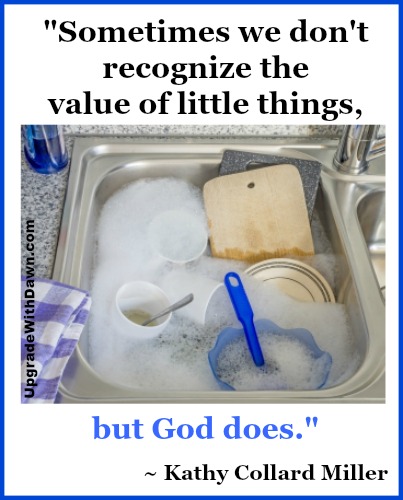
Sometimes we don’t recognize the value of little things, but God does. He says in Zechariah 4:10: “Do not despise these small beginnings, for the LORD rejoices to see the work begin" (NLT).

2. Recognize your motive for wanting to put things off.

I often wondered why I neglected doing the dishes. After all, instead of putting a dish into the sink or onto the counter, I could have used the same energy and time to stick it into the dishwasher—and it would be done!

Then one day after loading the dishwasher with dishes I could have loaded quickly over a day or two, I paid attention to my emotions. I recognized the sense of satisfaction in that moment. It felt good to transform the kitchen from messy to clean.

In a sense, my anticipation of that accomplishment had been rewarding—and motivating my procrastination. I knew I would feel like I had succeeded at something and so I didn’t complete the small tasks.

To combat procrastination, especially involving clutter, pay attention to your emotions. What emotion does waiting provide?

Whether it’s transforming a dirty kitchen or clearing off your desk, look to God for your satisfaction and joy. Anything that replaces Him is an idol. His approval is what we should seek because He wants to tell us, “Well done, good and faithful servant” (Matthew 25:21).

3. I’m afraid of the response I’ll receive for taking action.

Whereas we just talked about the satisfaction of success, we can also procrastinate because we fear the potential “pain” that’ll result from taking action.

Maybe you’ve been putting off responding to that email because you’re convinced whoever receives it will become angry. Or you don’t know exactly what to say to your friend and so you delay—waiting for just the right words to show up in your mind.

But in making those choices of delay we aren’t trusting God.

  • We’re trying to control the situation or another person so that we can protect ourselves from pain.
  • We’re leaning on our own ideas and that’s contrary to Proverbs 3:5-6: “Trust in the Lord with all your heart, and do not lean on your own understanding. In all your ways acknowledge him, and he will make straight your paths” (ESV).

If we recognize our procrastination as not trusting God, then we’re saying He can’t be in charge of the results.

Since He’s sovereign and therefore in charge of everything, He could literally bring a good result from our poor words, and He can bring an unexpected result (what seems negative at the time) from our good words.

We can’t control what happens but we can seek Him for wisdom; then take action and trust Him for the resulting “straightened path.”

I know these three ideas have been instrumental in seeing God’s work in empowering me to take action and increase my trust in Him.

In fact, just this morning, I responded to God’s prompting—finally—about suggesting a book idea to my agent. I really didn’t think he would like it and I feared the seeming “rejection.” But he quickly wrote back and said, “I like this and I think I know a publisher who would be interested.”

I don’t know what will happen, but for now I know I didn’t procrastinate (much!) and God may have a surprising result.

Which of those three insights could help you to resist procrastination?

Kathy Collard Miller loves to help women trust God more through her 50 books and her speaking in over 30 states and 8 foreign countries. Learn more about Kathy's unique ministry at her website/blog. Her latest book is Never Ever Be the Same: A New You Starts Today (Leafwood). 

Graphic adapted, Image courtesy of Mister GC at FreeDigitalPhotos.net.

Page 1 ... 2 3 4 5 6 ... 49 Next 5 Entries »