




A member of AWSA

  Member of AWSA

  Info about AWSA


[Bios on Partners Page]

Lina AbuJamra

Sue Badeau

Dianne Barker

Twila Belk

Gail Bones

Harriet Bouchillon

Mary Carver

Pamela Christian

Lisa Copen

Erin Davis

Diane Dean

Deb DeArmond

Kelly DeChant

Danna Demetre

Nancy Leigh DeMoss

Melissa Edgington

Debbi Eggleston

Pat Ennis

Morgan Farr

Pam Farrel

Renee Fisher

Liz Cowen Furman

Sheila Gregoire

Doreen Hanna

Holly Hanson

Becky Harling

Debbie Harris

Paula Hendricks

Nali Hilderman

Cathy Horning

Kathy Howard

Mary James

Priscilla Jenson

Lane P. Jordan

Rebecca Jordan

Ellie Kay

Maria Keckler

Sylvia Lange

Debby Lennick

Peggy Leslie

Kathi Lipp

Kathi Macias

Melissa Mashburn

Dianne Matthews

Cindi McMenamin

Elaine W. Miller

Kathy Collard Miller

Lynn Mosher

Karen O'Connor

Yvonne Ortega

Arlene Pellicane

Ava Pennington

Laura Petherbridge

Gail Purath

Marcia Ramsland

Kaley Rhea

Rhonda Rhea

Vonda Rhodes

Charlotte Riegel

Cynthia Ruchti

Julie Sanders

Deedra Scherm

Judy Scharfenberg

Laurel Shaler

Stephanie Shott

Poppy Smith

Stacie Stoelting

Jill Swanson

Janet Thompson

Janice Thompson

Teri Thompson

Brittany Van Ryn

Leslie Vernick

Laurie Wallin

Julie Watson

Joan C. Webb

Cherri Williamson

Kathy C. Willis

Jamie Wood

Dawn Wilson


Entries in Upgrade with Dawn (241)

Thursday
Feb182016

Mount Up with Wings as ... Horseflies?

Rhonda Rhea. Just thinking of her makes me smile. This God-centered humorist never fails to make me laugh ... and think. In this SPIRITUAL LIFE and ATTITUDE UPGRADE, she calls us to trust God in our struggles and learn to soar with Him.

"Unbelievable. First of all, it was the biggest horsefly-looking thing I’d ever seen," Rhonda says. "Was it a bird? A pterodactyl maybe?"

Didn't I (Dawn) tell you? She always has a funny perspective on life.

Rhonda continues . . .

More horse than fly, really. I think I could’ve saddled it. We’re talking about a horrifyingly large horsefly here. I read somewhere that the lifespan of the average horsefly is only a few days. If that’s true then this one had been alive for about four years.

But in addition to being huge, it was scary-strong.

The thing stayed on the windshield of my moving vehicle for 10 miles—during most of which I was clipping along at a speed of at least 55 miles per hour. What even WAS that thing?

He just kept staring through the windshield. Like he was creepily saying, “I’m keeping a compound eye on you.”

Also interesting was the fact that although it looked like he was having a hard time keeping his wings attached to his body, he could’ve just let go and flown away any time. But he just kept hanging on. I kind of wonder if he thought he was actually pulling the car.

How often do we struggle? Flapping our flimsy wings, thinking we’re hauling some heavy-duty situation along ourselves, acting for all the world like everything depends on us?

Hey, fellow-horseflies! We’re not pulling the car! It’s too heavy. It’s too big. It’s too…it’s just too “TOO.”

“Do you not know? Have you not heard? Yahweh is the everlasting God, the Creator of the whole earth. He never grows faint or weary; there is no limit to His understanding.  

He gives strength to the weary and strengthens the powerless. Youths may faint and grow weary, and young men stumble and fall, but those who trust in the Lord will renew their strength; they will soar on wings like eagles; they will run and not grow weary; they will walk and not faint” (Isaiah 40:28-31, HCSB).

The Lord knows our struggles. And He knows exactly what we need to be able to persevere, to overcome, to experience victory—to fly. He will strengthen us at our every weak place.

Horsefly wings? No thanks. How about that set of eagle wings instead. The key? It’s trust. “Those who trust in the Lord will renew their strength.”

The word for “trust” in Isaiah 40:31 is a word that includes the idea of looking eagerly for, lying in wait—expecting.

Oh blessed thought, expectantly knowing that the Lord will be our strength? That activates our strength! And it’s that trust that can launch us into victorious flight. Fifty-five mph? That’s nothing! No flapping and sputtering either. Peacefully soaring.

There’s nothing that’s “too anything” for our never-tiring, ever-trustworthy God.

Poor horsefly, he never soared. Before he finally let go and took off in a new direction, he looked a little like he’d taken a ride in a blender. We have choices too. Struggle to lift the car on our own and take a ride on blender blades, or let go in peaceful trust and let the Lord be our strength. And then…soar.

O Lord, let us trust in You in every struggle and soar in Your strength and peace!

As far as the bug on my windshield, I hope he doesn’t blame me for his lack of soaring. What if he decided to take revenge? It’d be like, an eye for an eye for an eye for an eye….

Are there struggles/obstacles weighing you down, keeping you from soaring? Ready to trust of the great God of the universe and let that trust outweigh all those temporary things?

Rhonda Rhea is a humor columnist and the author of 10 nonfiction books, including Espresso Your Faith and Join the Insanity—Crazy-Fun Life in the Pastors’ Wives Club. She also coauthors fiction with her daughter, Kaley Faith Rhea. Their first novel, Turtles in the Road, releases this fall with two more completed and coming soon. Rhonda speaks at conferences and events all over the country and she and her daughters host the TV show, That’s My Mom, for Christian Television Network’s KNLJ airing in mid-Missouri.

Photo in graphic from Morguefile.

Tuesday
Feb162016

The Secret to COMPASS-ionate Ministry

Sue Badeau and her husband are two of the most compassionate people I know. In her Ministry UPGRADE, we can learn how to pursue more compassion as we serve the Lord.

"As travelers today, we use GPS so we’ll know where we’re going," Sue says, "Yet, I remember traveling with my husband and children using a map, highlighter and compass."

Ever get lost? The first time I (Dawn) got lost, I sure wished I had one! A "compass" can keep us on track in a lot of ways, and Sue describes an important compass for ministry.

She continues . . . 

There are many great needs in the world – people who are hungry, without clean water, abused, homeless, wounded – the list goes on and on. It's easy to become overwhelmed.

Jesus calls me to compassion, but where do I begin?In the face of such overwhelming need, can I make a difference?

Sometimes I wish I had a compass pointing me to the "true north" of showing Christ-like compassion in a hurting, chaotic and self-absorbed world.

     Compass.      Compassion.

These words don’t have the same roots in their original languages, but in English, the similarity gives me pause. Is there a compass to compassion?

Can I find and follow true north, tuning out noisy static and tempting distractions?

A compass is an "instrument for finding direction." God’s Word provides a compass, clearly laying directions to a compassionate life and ministry.

 “When He went ashore, He saw a large crowd, and felt compassion for them and healed their sick" (Matthew 14:14 NASB).

A Compass for Compassion

E (East): EMPATHY

Compassion begins with a deep feeling. Jesus felt compassion. He was moved.

No one person, family or church can meet all the needs they encounter. The first secret to a compassionate ministry is to tune-in to those needs that you feel deeply.

My husband once read a letter about refugees. He felt their plight so deeply he was moved to open our home to them. Later, he told me, "I didn’t even have to pray about that one; the letter itself was an answer to a prayer already inside me."

Of all the needs you see, which ones move you most deeply?

 S (South): SEEING

 Compassion requires seeing the humanity of all people, especially the suffering. Jesus saw first and then was moved. Compassion is never earned and rarely deserved.

The second secret to a compassionate ministry is to see people as precious children of God.

Twenty-five years ago, the woman who started the homeless shelter where my husband works encountered a beggar. She asked his name. He began to cry, saying that no one had asked his name in years. She was the first to see him.

That simple yet profound exchange began a ministry that has served thousands. It began when she was able to see as God sees.

W (West): "WHAT shall I do?"

 Compassion always moves us to action. Jesus saw people, felt compassion for them and acted.

The third secret to a compassionate ministry is to act.

Don’t get bogged down in planning, prayer and preparation. Act. DO something.

N (North): "NOT about me."

 Exercising compassion can be exhausting, overwhelming and seemingly thankless. Always remember: its not about me.

We are able to feel and act with compassion because Jesus showed us great compassion when we did not deserve it.

True north on the compassion compass will always and continually point to Jesus.

Do you want to have a compassionate ministry?

  • Notice what moves you deeply.
  • See the humanity and dignity of all people.
  • Act on your feelings, and
  • Always stay true to Jesus.

What is one example of a need that moves you deeply today? Are you ready to act upon your feelings with compassion?

Sue Badeau is a nationally-known speaker, author and child welfare and trauma expert. Sue and her husband Hector are lifetime parents of twenty-two children—two by birth and twenty adopted. They wrote the book Are We There Yet: The Ultimate Road Trip Adopting and Raising 22 Kids. Learn more about Sue at suebadeau.com and badeaufamily.com.

Graphic of compass adapted, from Pixabay.

Thursday
Feb112016

Ways to Remember God's Goodness

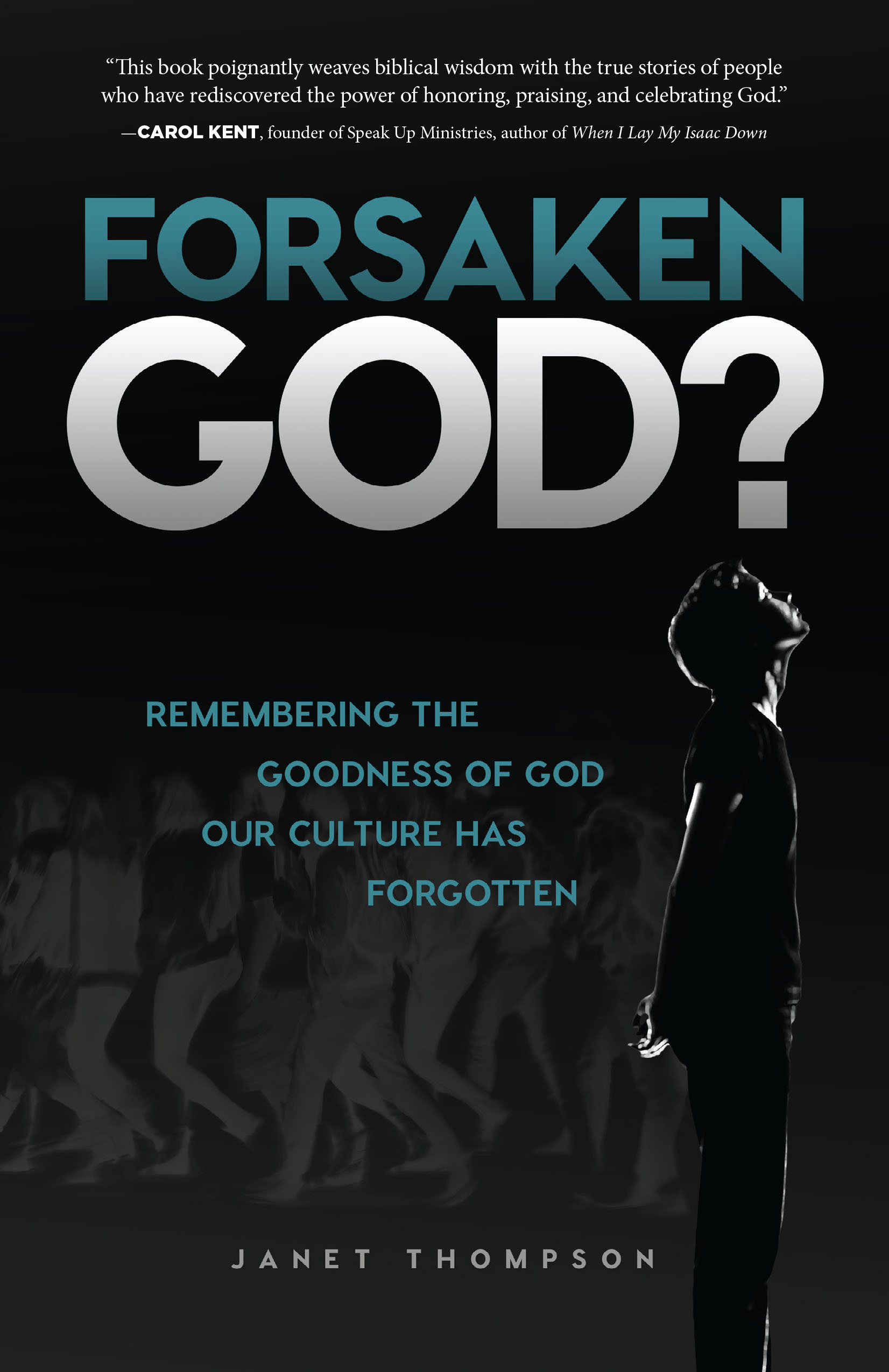
In this Spiritual Life UPGRADE, Janet Thompson says our forgetfulness of God needs to stop with this generation!

“If we don’t remember what God has already done, we won’t believe what he is capable of doing in the future.” Janet says. “Memory builds faith.”

I (Dawn) am excited with Janet’s new book on this topicForsaken God?—not only because I shared a story in the book*, but also because each story encourages us to remember our good and faithful Father God.  

Janet continues . . .  

Today’s culture is quickly forgetting the goodness and power of our Great God.

The Bible describes the potential destruction through all generations to people who forget God. The dangers are paramount. We read the Old Testament and lament at how forgetful the Israelites were of God’s goodness.

Every time He did something good for them, they started grumbling that they needed something else. They repeatedly rejected God, even though He:

  • freed them from bondage and slavery by miraculously parting the Red Sea for them to pass through on dry ground,
  • provided manna from heaven,
  • guided them with a pillar of cloud by day and a pillar of fire by night,
  • never let their shoes wear out even after walking for 40 years,
  • and he offered them a land flowing with milk and honey.

God was only as good as the next miracle or provision. A forsaken God.

“But watch out! Be careful never to forget what you yourself have seen. Do not let these memories escape from your mind as long as you live! And be sure to pass them on to your children and grandchildren” (Deuteronomy 4:9 NLT).

We wonder at how the Israelites could be so blind and ungrateful. Why couldn’t they trust that a God who provided and protected them in the past, would do the same in the present and future?

But their memories were short. As often as Moses and God tried to help them remember, still they forgot. And at great sacrifice. The original generation freed from Egypt never got to see the Promised Land because they doubted God’s goodness. Even Moses wasn’t able to enjoy its beauty because at a crucial moment, he took matters into his own hands and forgot that God was in control.

We shake our heads at how dense and blind they were. But wait . . . can’t we be guilty of the same forgetfulness?

God has done amazing things in our lives too, but when the next crisis arises, we panic that He might not show up for us this time. Or when prayers are answered, we take credit ourselves or offer praise to someone else instead of giving God the glory and recognition He deserves.

But forgetfulness needs to stop with our generation. We live in a world that is quickly trying to eliminate God from the public square and even in the private domain.

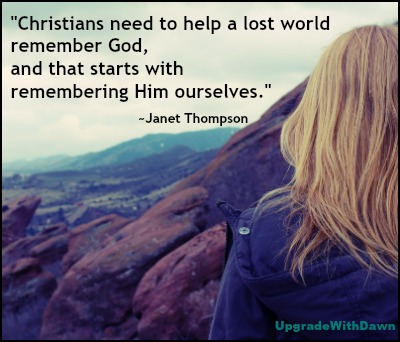
Christians need to help a lost world remember God, and that starts with remembering Him ourselves.

In Forsaken God?: Remembering the Goodness of God Our Culture Has Forgotten, there are suggestions for ways to remember all that God has done in your life and then experience the power of sharing those memories in your sphere of influence and with the next generation.

One effective way is to share our testimony. As a Christian speaker, I give parts of my testimony every time I speak. “Feed my sheep” is my testimony of God clearly speaking those words to me. When I said an obedient “OK,” he revealed the "sheep" were women and "feeding" was mentoring.

That was 20 years ago, and today God has taken Woman to Woman Mentoring around the world as women enjoy the blessings of being in Titus 2 mentoring relationships. I still stand in awe as I write that story and every time I tell it from the stage. I will never forget how God used me to start a worldwide ministry and I give him the glory for the blessing it has been to so many.

But you don’t have to be a speaker to share your story.

Someone today needs to hear how Jesus changed your life. Our hurting world needs to hear from the Christian world the source of our joy and peace. Mentoring is a great way to share our testimony to encourage other women to know the Jesus of the Bible that we know.

In Forsaken God? there are over 50 ways to help us remember God.

Here are just a few:

  • Taking pictures
  • Journaling
  • Reading our Bibles
  • Receiving Communion
  • Making a thankful list
  • Joining a small group

What are some ways that help you remember God’s goodness?

Note: This article includes excerpts of Forsaken God: Remembering the Goodness of God Our Culture Has Forgotten, shared with permission. Dawn’s story appears on pages 121-122.

Janet Thompson is an international speaker, freelance editor, and an award-winning author of 18 books including Dear God, They Say It’s Cancer and Praying for Your Prodigal Daughter. She is also the founder of Woman to Woman Mentoring and About His Work Ministries. Each chapter in her new book, Forsaken God?: Remembering the Goodness of God Our Culture Has Forgotten, includes questions and conversation starters for discussion in small groups, Bible study groups, book clubs, mentors and mentees or with family and friends. It is available at Christian bookstores, Amazon, Christianbook.com, and signed at author’s website.

Graphic adapted, courtesy of pixabay.com.

Tuesday
Feb092016

Add Some Color to Your Quiet Time

Morgan Farr is a strong woman both physically and spiritually, yet she struggled with Quiet Time. In this Spiritual Life UPGRADE, she shares how she overcame her frustration.

Morgan asks, "Have you ever just dreaded doing your quiet time? Does it feel like doing what you are supposed to do, but it just doesn’t feel personal?"

Yes, that's a problem I (Dawn) have encountered many times, and God gave me a solution almost identical to what Morgan is going to share here!

Morgan continues . . .

Quiet time is one of those Christian phrases that can be overwhelming to new believers. As someone that didn’t have a relationship with Jesus until my 20s I can tell you, I used to be so very frustrated with "quiet time."

I tried everything that people suggested to be diligent in reading my Bible and none of it fit.  

A few things I have tried: 

  • Reading just my Bible  
  • Reading my Bible with with a Bible commentary 
  • Reading my Bible with a concordance   
  • Reading my Bible and taking detailed, organized notes 
  • Following a Bible-reading plan 
  • Reading through the Bible in a year 

None of it really stuck and that made me feel like the worst Christian ever.

I mean, really, what kind of Christian dreads quiet time?

Finally, one of my mentors suggested that I think about what makes me … ME.

After really thinking about it, I realized I like the academic side of studying the Bible. I love to study, but that isn’t enough. A quiet time is so much more than just studying. Quiet time is your time to communicate with God.  

So how would I have a quiet time and personalize it between just God and me? He is the creator of the universe.

When it hit me that the Creator of the universe loves me and wants a relationship with me, that changed everything.

The Artist of the universe, the Creator of color wants a relationship with me! So why can’t I add color in my quiet time?

I am that person who loves nothing more than a brand new pack of crayola markers, so using color in my quiet time just seemed natural.  

But how do you do it?  

I am sure many of you have heard of Bible journaling. If you google itor check it out on Pinterestyou will find all kinds of really awesome examples. They are beautiful and delicate.

I tried my hand at it. But honestly it was a little much for me. I didn’t want to make a mistake in my Bible. I am an absolute perfectionist and the idea of illustrating in my Bible made me very nervous. I was unable to actually do my quiet time.

Since Bible journaling was too much, I had to come up with something else.

In lieu of creating an actual drawing in my Bible, I use a system of color-coded symbols to mark the text of my Bible. I gathered up the symbols from around the internet, and the colors were based off of my associations with each group.

What does my Bible marking key look like?

Purple is God’s "team members" (Father, Son, Holy Spirit...)

Red is the cost of our salvation (blood, cross, sacrifice...)

Orange is sin. because it makes me think of traffic warnings (lust, cursed, suffering...)  

Brown is all the things with earth (nation, land, home...)

Blue is the things we give back to God (prayer, repentance, believe...)

Green is the things God does for us (grace, bless, forgiveness...)

Pink is for family interaction (family, marriage, child...)

Using this system has made me so much more willing to do my quiet time! I like being able to look back at a text and see if it was more about the cost of our salvation or the gifts that God has given us.

I also like that it doesn’t take forever to complete my daily reading using this method. Having a one-year-old, writing a blog and running a full-time, functional fitness gym ministry doesn’t leave a lot of down time.

That means I have to be even more diligent about utilizing my quiet time with God to the best of my abilities. In Colossians 3:17, we read,

“And whatever you do, whether in word or deed, do it all in the name of the Lord Jesus, giving thanks to God the Father through him.”

I am so grateful that God made me just the way He wanted to, with a love of Him and the color He created.

Does this sound like a system you might use? Do you use a different kind of coding in your Quiet Time?

Morgan Farr is an Army wife currently stationed at Fort Bragg in Fayetteville, North Carolina, with her wonderful husband Brian and their seven-month-old son, William. She is a homemaker who dedicates her free time to ministering to other Army wives through Bible studies, one-on-one interactions and physical training. Morgan writes about her transition out of feminism and into biblical womanhood on her blog. You can find her training programs on her blog, FarrFunctionalFitness.blogspot.com.

Friday
Feb052016

Fenced in by Love (Part 2)

In part 1 of "Fenced in By Love," we saw that God keeps and preserves His own "sheep"--the souls of those who love Him and are in a personal relationship with Him. 

Today, we're considering HOW and WHY God keeps His people.

This is important, because I (Dawn) think there is sometimes a misunderstanding when people think God has forgotten them in their difficulties. The truth is, God is always up to something beyond what we might be able to see or understand.

So let's continue . . .

3. HOW is the the Lord keeping His people?

This goes back to the words "keep" and "preserve." Does being kept by the Lord mean God's people will never suffer? No, it's clear from scripture that believers will suffer (Psalm 6:6-7; Psalm 71:20a).

The harmful effects of the Fall in Genesis 3 will touch all of us this side of heaven. We may suffer persecution and even death. But we can be steadfast in the midst of the most desperate trials (James 1:12; 1 Peter 1:6-9).

The Christian's perspective on suffering is far different from those without the Lord. Instead of fighting the testing process of our circumstances, we can ask for our Father's will to be accomplished, learn to see life's trials as a blessing as we seek His perspective, and ask Him for wisdom to proceed.

We are never left alone in this process. Our Father knows we are weak and this is an uncertain world, and we cannot fully protect ourselves.

He is "watching over the way of His saints" (Proverbs 2:8). I have no doubt, if we could lift the veil between heaven and earth, we would see His care and protection in countless ways: the car that missed hitting us, the poison we missed ingesting, the thief who somehow couldn't find our front door, etc.

Yes, many things do happen to us in this sinful world, but ...

We are proud people indeed if we think we are not in God's constant, loving watchcare.

Back to Psalm 121:7 for a moment. The tense of the word "keep" in that verse includes the future. It means God will keep us both now and forever. He is with us and helping us in our current troubles, and and He will ultimately rescue us from ALL our troubles.

God, in His perfect and loving will, may not rescue us from all our troubles in the here and now, but the Lord has promised protection from our ultimate enemy, sin (Romans 6:14). Sin no longer has the power to enslave us or determine where we will spend eternity, if we are in Christ. But we do have a choice about sin.

In other words, our future is secure in Christ, and no one can snatch us out of our Father's strong hand! (John 10:28-29); but will we trust Christ and live now under His provided protection, or will we go beyond the fence of His love and "sleep with the enemy," giving in to sin's control?

4. WHY is the Lord keeping His people?

Way back in Genesis, God told Jacob, "I am with you and will watch over you wherever you go ... I will not leave you until I have done what I have promised you" (Genesis 28:15).

God has always watched over His people, not only because He loves them, but also to accomplish His purposes in and through them.

God absolutely has the ability to deliver His people, but it is not always His will to do so. For example, in His love He may allow a physical trial or some other trouble in order to purify us (James 1:2-3) or to show Himself strong in our declaration of faith (as happened with the patriarch, Job).

Sometimes Christians pay the ultimate price for their identification with Christ and their witness, as did the first Christian martyr, Stephen (Acts 6:8-7:53). God doesn't ask everyone to make the ultimate sacrifice, but He does call us to be faithful soldiers in the battle, wherever that leads us (Ephesians 6:12-20; 1 Peter 3:15).

Romans 8:28-30 explains God's ongoing and ultimate purpose for ALL of His children (the "saints" of verse 27):

"And we know that for those who love God all things work together for good, for those who are called according to his purpose. For those whom he foreknew he also predestined to be conformed to the image of his Son, in order that he might be the firstborn among many brothers. And those whom he predestined he also called, and those whom he called he also justified, and those whom he justified he also glorified."

Our Father wants us to be like His Son; and He lovingly, faithfully chisels away anything that doesn't look like Jesus.

So we read these powerful words in verse 31: "What then shall we say to these things? If God is for us, who can be against us?"

  • It's not that we will escape bodily harm (v. 36)—we may even be called to martyrdom; 
  • but rather, we are "more than conquerors though him who loved us" (v. 37)—we have spiritual and eternal victory in Jesus;
  • and nothing will ever be able to separate us from the love of God in Jesus, our Lord (vv. 38-39). We are sealed for eternity through the indwelling Holy Spirit (Ephesians 1:13-14).

No matter our circumstances, God is watching and involved with eternal purposes for our lives.

We are forever fenced in by God's love!

Are you struggling with a deep problem? How does a fresh perspective on God's purposes for you encourage you today?

Dawn Wilson, founder and President of Heart Choices Today, is the creator of three blogs:Heart Choices Today, LOL with God (with Pam Farrel), and Upgrade with Dawn. She is the Director of the San Diego chapter of Network of Evangelical Women in Ministry (NEWIM San Diego) and is a contracted researcher for Revive Our Hearts. She and her husband Bob have two grown, married sons, three granddaughters and a rascally maltipoo, Roscoe.

Church graphic adapted from pixabay.com.

Chisel graphic adapted, Image courtesy of bugtiger at FreeDigitalPhotos.net.